Grand Strategy · Diplomacy · The Allies
The Declaration by United Nations
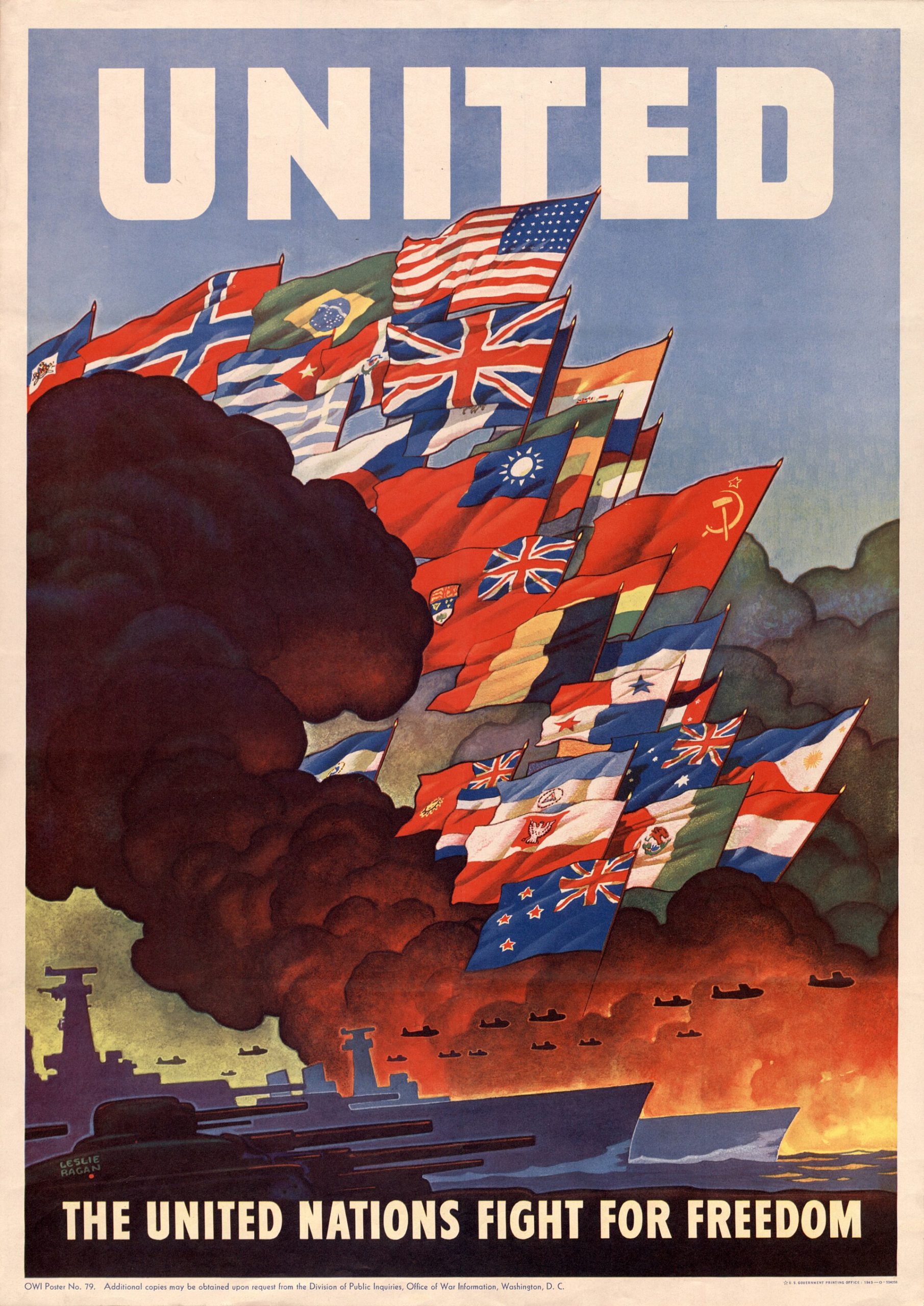
Weeks after Pearl Harbor, the nations fighting the Axis sign a single pledge in Washington. Their name for themselves will outlive the war.
- Location
- The White House, Washington
- First signatories
- United States, United Kingdom, Soviet Union and China
- Total signatories
- 26 nations by the following day
- Commitment
- Full resources to the war; no separate peace
- War clock
- Day 854 of 2,194
In late December 1941 Winston Churchill was staying at the White House for the Arcadia Conference. With the United States now at war, he and Franklin Roosevelt wanted a formal statement binding together every nation fighting Germany, Italy and Japan. The draft drew on the Atlantic Charter that the two leaders had agreed in August 1941.
A new name
Roosevelt chose the name: the United Nations. It replaced the clumsier term “Associated Powers” and stressed unity rather than a formal military alliance. On New Year’s Day 1942 Roosevelt and Churchill signed the declaration, along with the Soviet ambassador Maxim Litvinov and China’s foreign minister T. V. Soong. Representatives of 22 more nations, including South Africa, Australia, Canada, India and New Zealand, along with governments in exile from occupied Europe, signed the next day.
The pledge
The text was short. Each government committed its full military and economic resources against the Axis members with which it was at war, promised to cooperate with the other signatories, and undertook not to make a separate armistice or peace. More nations joined as the war went on.
Also on 1 January
- 1945The Luftwaffe launches Operation Bodenplatte, a surprise attack on Allied airfields in the Low Countries, losing hundreds of aircraft and many irreplaceable pilots.
Sources and further reading
Lead image: A 1943 poster celebrating the United Nations alliance, by Leslie Ragan. Leslie Ragan, US Office of War Information, Public domain, via Wikimedia Commons. See our sources and image policy.
 United Kingdom
 United States
 Soviet Union
 Germany
 Japan
 France
 Poland
 South Africa