Arctic · War at Sea · United Kingdom vs Germany
The Battle of the Barents Sea
A heavy cruiser and a pocket battleship attack an Arctic convoy guarded only by destroyers. The escorts hold them off, and Hitler’s fury will end the career of his navy’s chief.
- Location
- Barents Sea, north of Norway
- Convoy
- JW 51B, bound for Murmansk
- Escort commander
- Captain Robert Sherbrooke, Royal Navy
- Result
- Convoy arrives intact; German force withdraws
- War clock
- Day 1,218 of 2,194
Convoy JW 51B sailed for the Soviet Union in December 1942 with 14 merchant ships, escorted by six destroyers and some smaller warships under Captain Robert Sherbrooke. German intelligence spotted it, and a powerful force sailed from Norway to destroy it: the heavy cruiser Admiral Hipper, the pocket battleship Lützow and six destroyers. The plan was for Hipper to draw the escorts away so that Lützow could fall on the merchant ships.
The destroyers stand firm
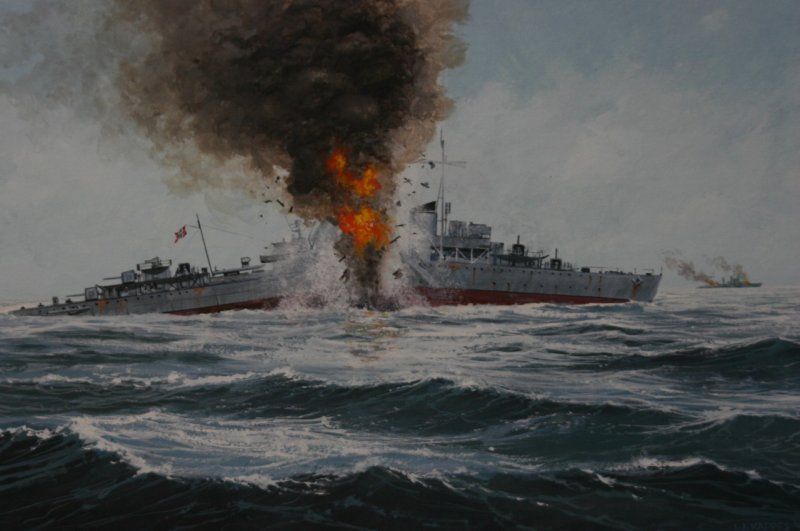
On the morning of 31 December, in the near-darkness of the Arctic winter, Hipper attacked. Sherbrooke’s destroyers turned towards her, feinting torpedo attacks and laying smoke to shield the convoy. Sherbrooke was badly wounded when his ship, Onslow, was hit, but the escorts kept the German ships at bay. The destroyer Achates was sunk while screening the convoy, and the minesweeper Bramble was lost.
The cruisers arrive
Then the British cruisers Sheffield and Jamaica, which had been covering the convoy from a distance, arrived and hit Hipper, which was also damaged, and sank the German destroyer Friedrich Eckoldt. Under orders to avoid risks to his heavy ships, the German commander broke off. The convoy reached the Soviet Union without losing a merchant ship. Sherbrooke was awarded the Victoria Cross.
Sources and further reading
Lead image: The Battle of the Barents Sea, a painting by Irwin J. Kappes. Irwin J. Kappes, CC BY-SA 3.0 (licence), via Wikimedia Commons. See our sources and image policy.
 United Kingdom
 United States
 Soviet Union
 Germany
 Japan
 France
 Poland
 South Africa