Pacific · Land Battles · Japan vs United States and the Philippines
The Fall of Manila
Declared an open city to spare it from destruction, the Philippine capital is occupied by the Japanese army as American and Filipino forces fall back to Bataan.
- Location
- Manila, Philippines
- Belligerents
- Japan vs United States and the Philippine Commonwealth
- Japanese commander
- Lt Gen Masaharu Homma, 14th Army
- Result
- Manila occupied; defenders hold Bataan and Corregidor
- War clock
- Day 855 of 2,194
Japanese forces landed on Luzon in December 1941, at Lingayen Gulf in the north and Lamon Bay in the south. General Douglas MacArthur’s plan to meet them on the beaches failed, and his American and Filipino troops were forced into a fighting retreat. He fell back on the pre-war plan: withdraw to the Bataan peninsula and the island fortress of Corregidor and hold out there for relief.
An open city
To spare Manila’s population from bombardment and street fighting, MacArthur declared it an open city on 26 December and withdrew his forces. President Manuel Quezon and the Commonwealth government moved to Corregidor. Japanese aircraft continued to bomb the port area regardless.
Occupation
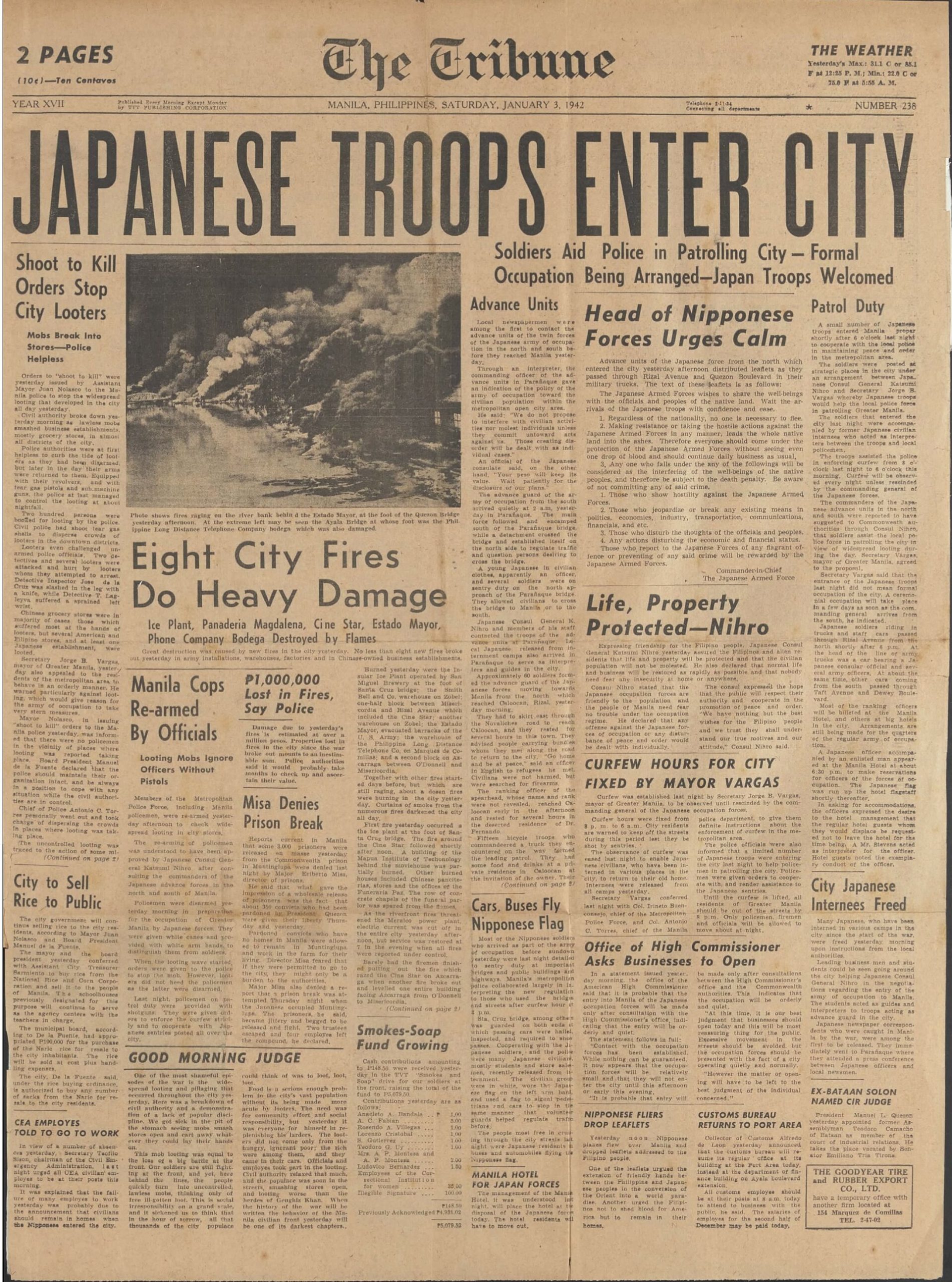
On 2 January 1942 troops of General Masaharu Homma’s 14th Army entered the city. The American naval base at Cavite was taken the same day. Thousands of American, British and other Allied civilians were interned at the University of Santo Tomas, where many would remain for more than three years. Filipinos faced a harsh occupation, while the defenders on Bataan prepared for a siege.
Sources and further reading
Lead image: Newspaper front page reporting the fall of Manila, January 1942. Unknown photographer, Public domain, via Wikimedia Commons. See our sources and image policy.
 United Kingdom
 United States
 Soviet Union
 Germany
 Japan
 France
 Poland
 South Africa