Eastern Front · Land Battles · Soviet Union vs Germany
The Counter-Offensive at Moscow
In temperatures far below freezing, the Red Army launches a surprise counter-offensive against the exhausted German armies outside Moscow. For the first time, the Wehrmacht is thrown back.
- Location
- Approaches to Moscow
- Belligerents
- Soviet Union vs Germany
- Soviet commander
- General Georgy Zhukov, Western Front
- Result
- German armies pushed back 100 to 250 km by January
- War clock
- Day 827 of 2,194
By early December 1941 German spearheads had reached within sight of Moscow. Some patrols were close enough to see the towers of the Kremlin. But the German armies were exhausted after six months of continuous fighting. They had no winter clothing, their vehicles and weapons froze, and their supply lines stretched back across hundreds of kilometres of ruined roads.
Fresh divisions
The Soviet high command had been quietly gathering reserves, including divisions transferred from Siberia and the Far East once Stalin was confident that Japan would not attack the Soviet Union. On 5 December the Kalinin Front attacked north of Moscow. The next day General Georgy Zhukov’s Western Front and the neighbouring fronts joined in along a wide arc around the capital.
The first great retreat
The blow fell on German troops who had no prepared defensive positions. Panzer groups that had been within striking distance of Moscow were forced back, abandoning vehicles and guns in the snow. Hitler ordered his troops to stand fast and dismissed the army’s commander-in-chief, Walther von Brauchitsch, taking command of the army himself. By January the front had been pushed back between 100 and 250 kilometres.
The Soviet offensive eventually overreached and stalled in early 1942, but Moscow was safe.
Also on 5 December
- 1941Britain’s ultimatum to Finland, Hungary and Romania expires without a reply; declarations of war follow the next day.
Sources and further reading
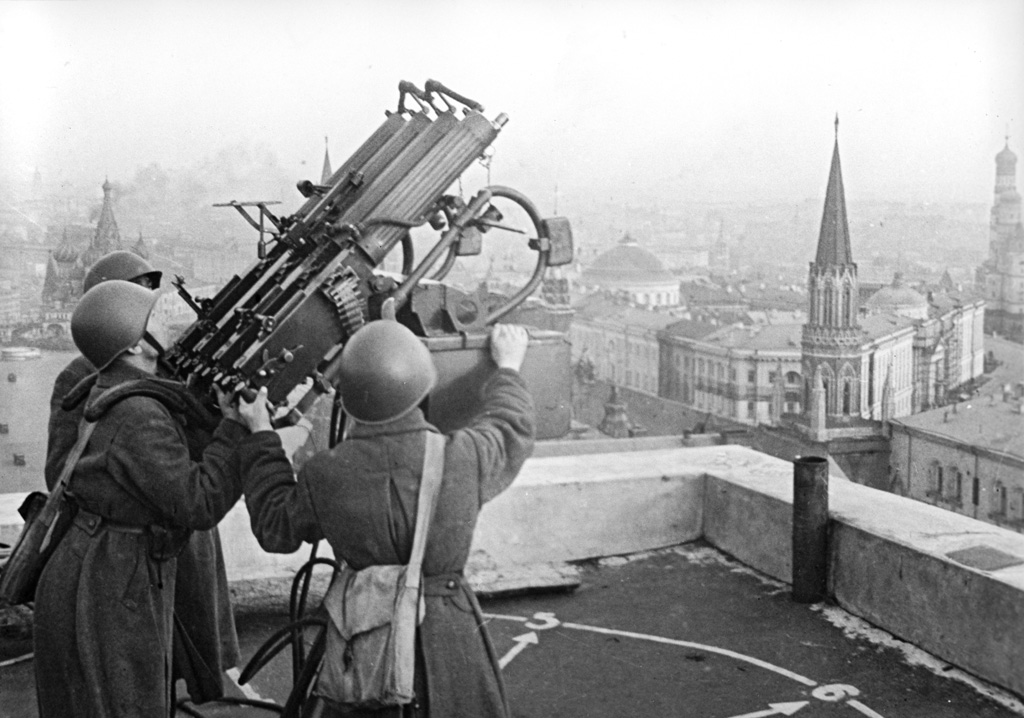
Lead image: Soviet troops in the defence of Moscow, December 1941. Knorring / Олег Кнорринг, CC BY-SA 3.0 (licence), via Wikimedia Commons. See our sources and image policy.
 United Kingdom
 United States
 Soviet Union
 Germany
 Japan
 France
 Poland
 South Africa