Western Europe · Air War · Allies vs Germany
The Air Offensive Against the V-1 Sites Begins
Allied bombers start attacking the concrete launch ramps hidden in the woods of northern France, from which Germany plans to fire its flying bombs at London.
- Targets
- V-1 launch sites in northern France
- Campaign
- Operation Crossbow; attacks on the ski sites from 5 December 1943
- Sorties
- 68,913 in the whole campaign
- Airmen killed
- More than 700
- First V-1s on Britain
- Night of 12 to 13 June 1944
- War clock
- Day 1,557 of 2,194
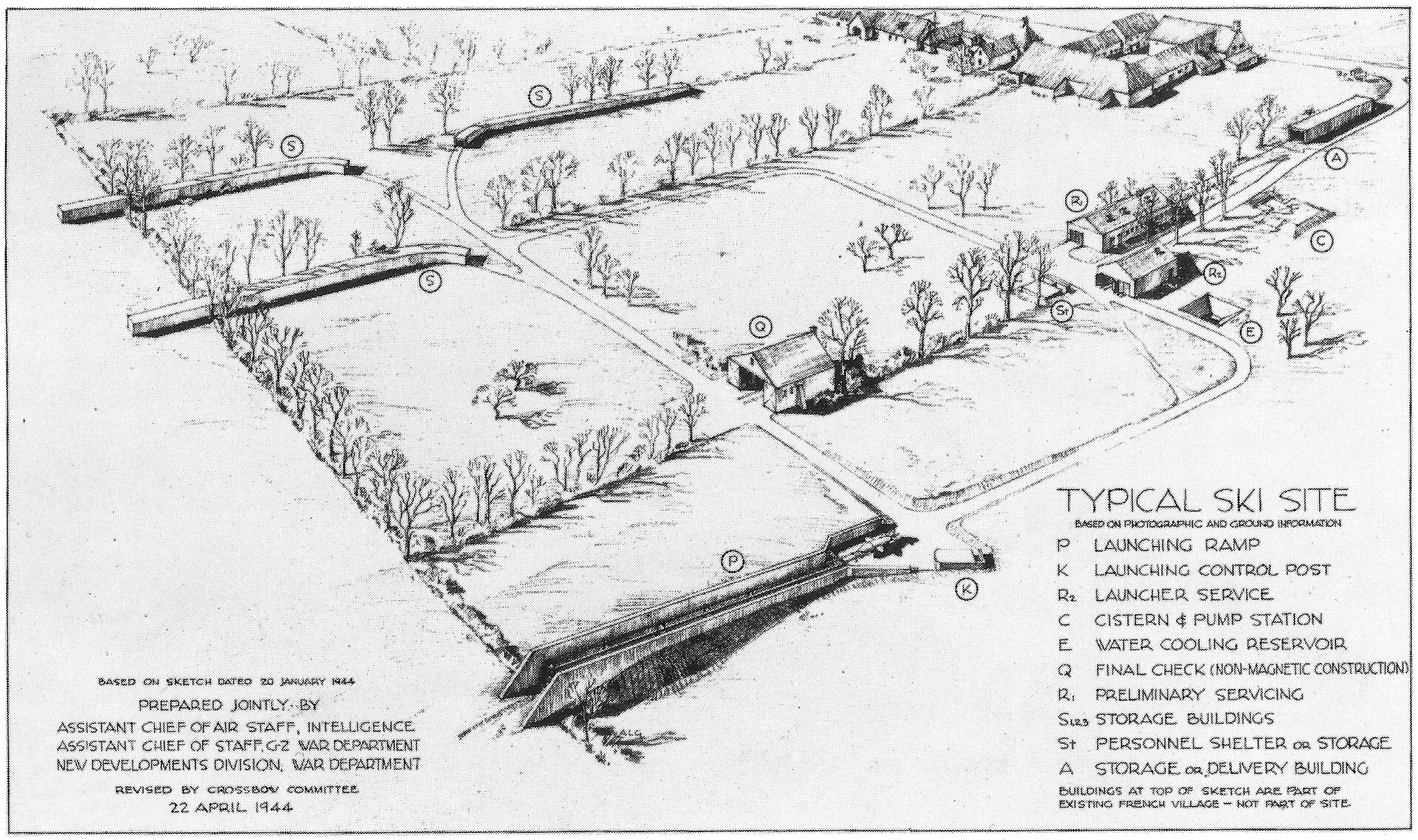
By the autumn of 1943 Allied intelligence knew that Germany was preparing new long-range weapons. Reconnaissance photographs of northern France showed dozens of strange building sites in woods and orchards, each with a concrete ramp pointed towards England and storage buildings curved like skis lying on their side. The Allies called them ski sites. They were launch bases for the V-1 flying bomb.
Crossbow
Peenemünde, the weapons research centre on the Baltic, had been bombed in August 1943. In November the effort against the German long-range weapons was reorganised under the code name Crossbow. On 5 December 1943 Allied aircraft began attacking the ski sites themselves.
The planned network had 96 fixed launching sites. Over half were complete by December, and by the end of January 1944 the Allies had identified all 96. By the end of 1943, 54 had been attacked and 7 destroyed; by May 1944, 24 were destroyed and 58 seriously damaged.
A delay, not a victory
The Germans adapted, switching to smaller, well-camouflaged modified sites that were far harder to find and hit. Over the whole campaign, Crossbow absorbed 68,913 Allied sorties, and more than 700 airmen were killed. The first flying bombs fell on Britain on the night of 12 to 13 June 1944, a week after D-Day.
Sources and further reading
Lead image: A V-1 launch site of the type the Allies called a ski site. US Army Air Forces, Public domain, via Wikimedia Commons. See our sources and image policy.
 United Kingdom
 United States
 Soviet Union
 Germany
 Japan
 France
 Poland
 South Africa