Western Europe · Land Battles · United States vs Germany
The Fall of St. Vith
After five days holding a vital Belgian road junction against overwhelming odds, the US 7th Armored Division pulls out of St. Vith, having thrown the German offensive badly off schedule.
- Location
- St. Vith, Belgium
- Dates
- 16 to 21 December 1944
- US forces
- 7th Armored Division, with parts of the 106th, 28th and 9th Armored Divisions
- Strength
- About 22,000 Americans against more than 100,000 Germans
- US losses
- About 12,500 killed, wounded, captured or missing
- War clock
- Day 1,939 of 2,194
When Germany launched its Ardennes offensive on 16 December 1944, the small Belgian town of St. Vith stood in the way. Several roads and a railway met there, and the German plan called for it to be taken by 18:00 on 17 December so that the armoured spearheads could race west towards the Meuse.
The horseshoe
The US 7th Armored Division, rushed south from the Netherlands, arrived in time to form a defensive horseshoe east of the town, under Brigadier General Bruce C. Clarke. With remnants of the 106th Infantry Division, whose other regiments had been surrounded on the Schnee Eifel, and elements of the 28th Infantry and 9th Armored Divisions, about 22,000 Americans held off a German force several times their size.
For five days the defenders blocked the roads through St. Vith, forcing German columns into long detours and traffic jams. By 21 December the position had become untenable. Around 21:30 that night Clarke ordered a withdrawal to the west, and German troops entered the town. The surviving units fell back across the Salm River by 23 December.
Sources and further reading
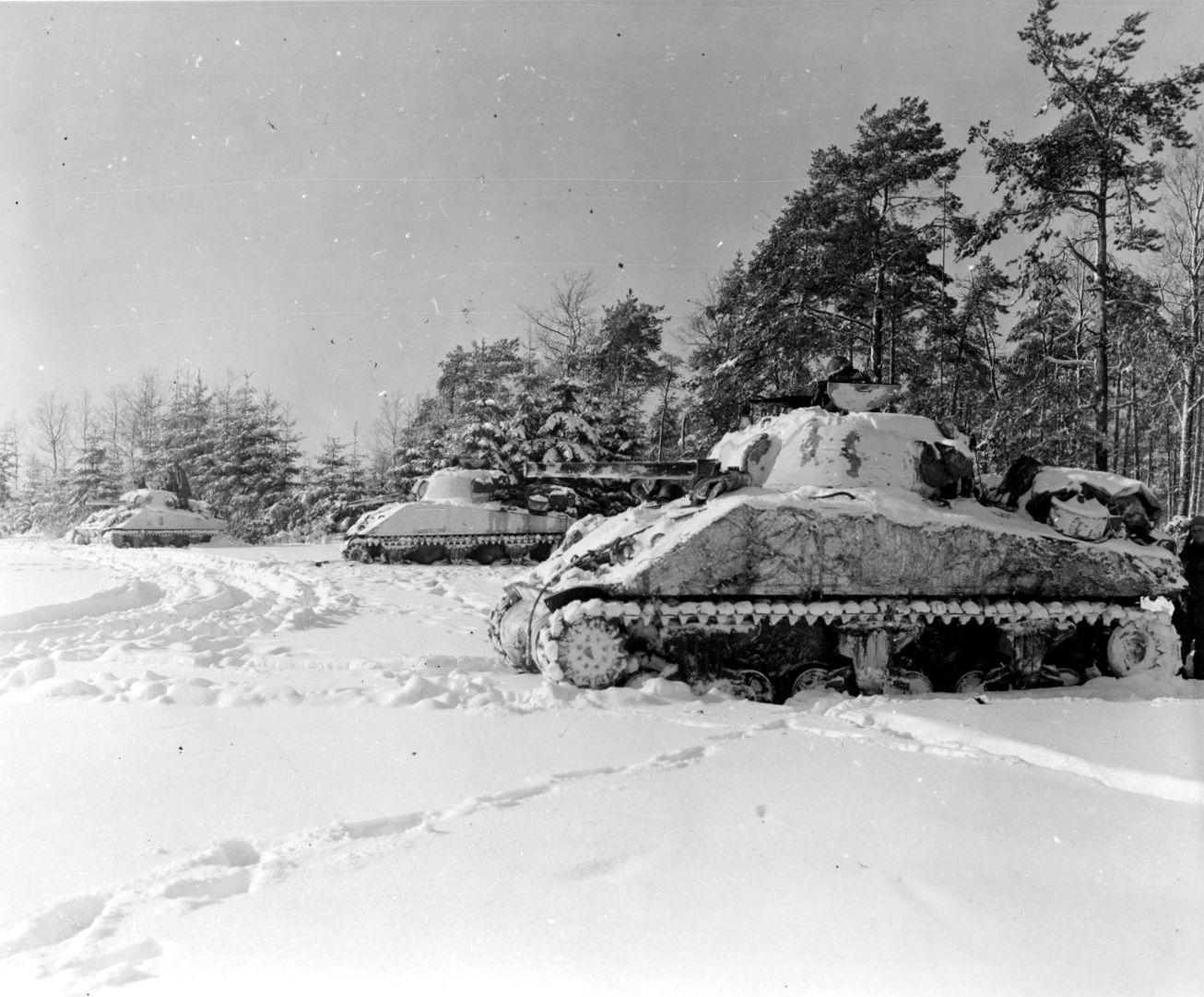
Lead image: Shermans of the US 7th Armored Division near St. Vith, Belgium. Salis, U.S. Army Signal Corps photo 111-SC-199467, Public domain, via Wikimedia Commons. See our sources and image policy.
 United Kingdom
 United States
 Soviet Union
 Germany
 Japan
 France
 Poland
 South Africa