Western Europe · Raids · United Kingdom vs Germany
Operation Frankton: The Cockleshell Heroes
From a submarine off the French coast, ten Royal Marines set out in canvas canoes to paddle a hundred kilometres up the Gironde and mine German blockade runners in Bordeaux.
- Launched from
- Submarine HMS Tuna, off the Gironde estuary, France
- Commander
- Major Herbert “Blondie” Hasler, Royal Marines
- Force
- 10 men in 5 canoes (one more canoe damaged at launch)
- Attack
- Night of 11 to 12 December 1942, Bordeaux and Bassens
- Survivors
- 2: Hasler and Marine Bill Sparks
- War clock
- Day 1,194 of 2,194
Bordeaux was a vital port for German blockade runners, fast merchant ships that carried rubber and other scarce materials from the Far East. Bombing the port risked heavy civilian casualties, so Combined Operations accepted a daring plan from Major Herbert Hasler of the Royal Marines: men in collapsible canoes would paddle up the river at night and attach limpet mines to the ships.
Into the Gironde
On the evening of 7 December 1942 the submarine HMS Tuna surfaced off the mouth of the Gironde. Six Cockle Mark II canoes were to be launched, but one was damaged coming out of the hatch, so ten men set off in five boats. Only two canoes reached the target: Catfish, with Hasler and Marine Bill Sparks, and Crayfish, with Corporal Albert Laver and Marine William Mills.
The attack
Paddling by night and hiding by day, they covered the long route up the river. On the night of 11 December they placed their limpet mines on ships at Bordeaux and Bassens. The explosions damaged six ships, several of them severely.
Hasler and Sparks escaped overland and, with help from the French Resistance, reached Spain and eventually Britain. Their comrades were less fortunate. Two men died of hypothermia; six others were captured and executed under Hitler’s Commando Order.
Sources and further reading
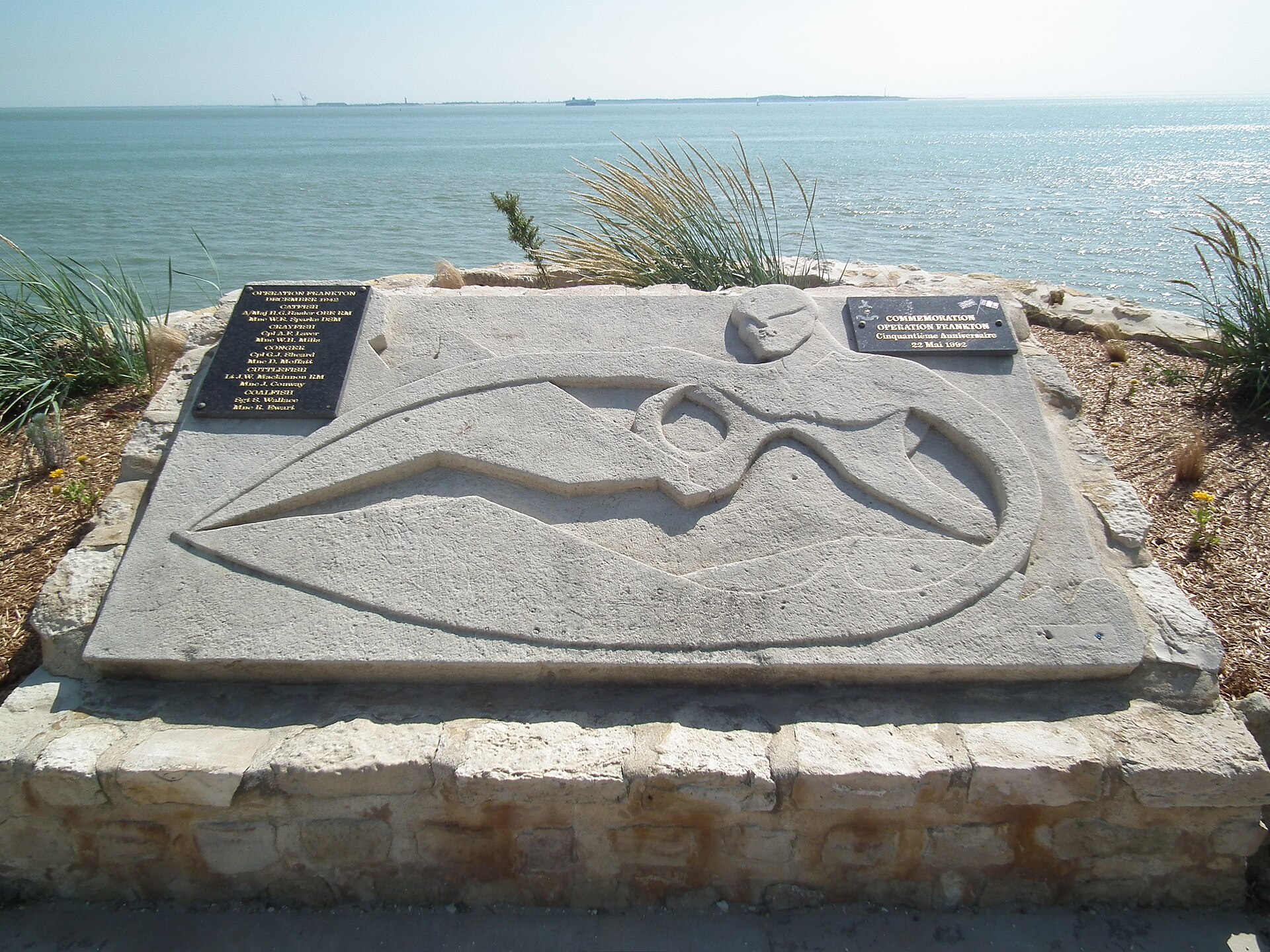
Lead image: The memorial to the men of Operation Frankton. Cobber17, CC BY 3.0 (licence), via Wikimedia Commons. See our sources and image policy.
 United Kingdom
 United States
 Soviet Union
 Germany
 Japan
 France
 Poland
 South Africa