Pacific · Air War · Japan vs United States
Pearl Harbor
Just before 08:00 on a Sunday morning, more than 350 Japanese carrier aircraft strike the US Pacific Fleet at its base in Hawaii. In under two hours the war becomes global.
- Location
- Pearl Harbor, Oahu, Hawaii
- Attackers
- 353 aircraft from six Japanese carriers
- US losses
- 2,403 killed; 4 battleships sunk, 4 damaged
- Japanese losses
- 29 aircraft and 5 midget submarines
- War clock
- Day 829 of 2,194
The Japanese striking force had crossed the North Pacific in radio silence, undetected. Before dawn on 7 December 1941 it reached its launch point about 400 kilometres north of Oahu. At 07:48 local time the first wave of fighters, dive bombers, torpedo bombers and high-level bombers arrived over Pearl Harbor. A radar station had detected them, but the warning was dismissed as a flight of American bombers expected from the mainland.
Battleship Row
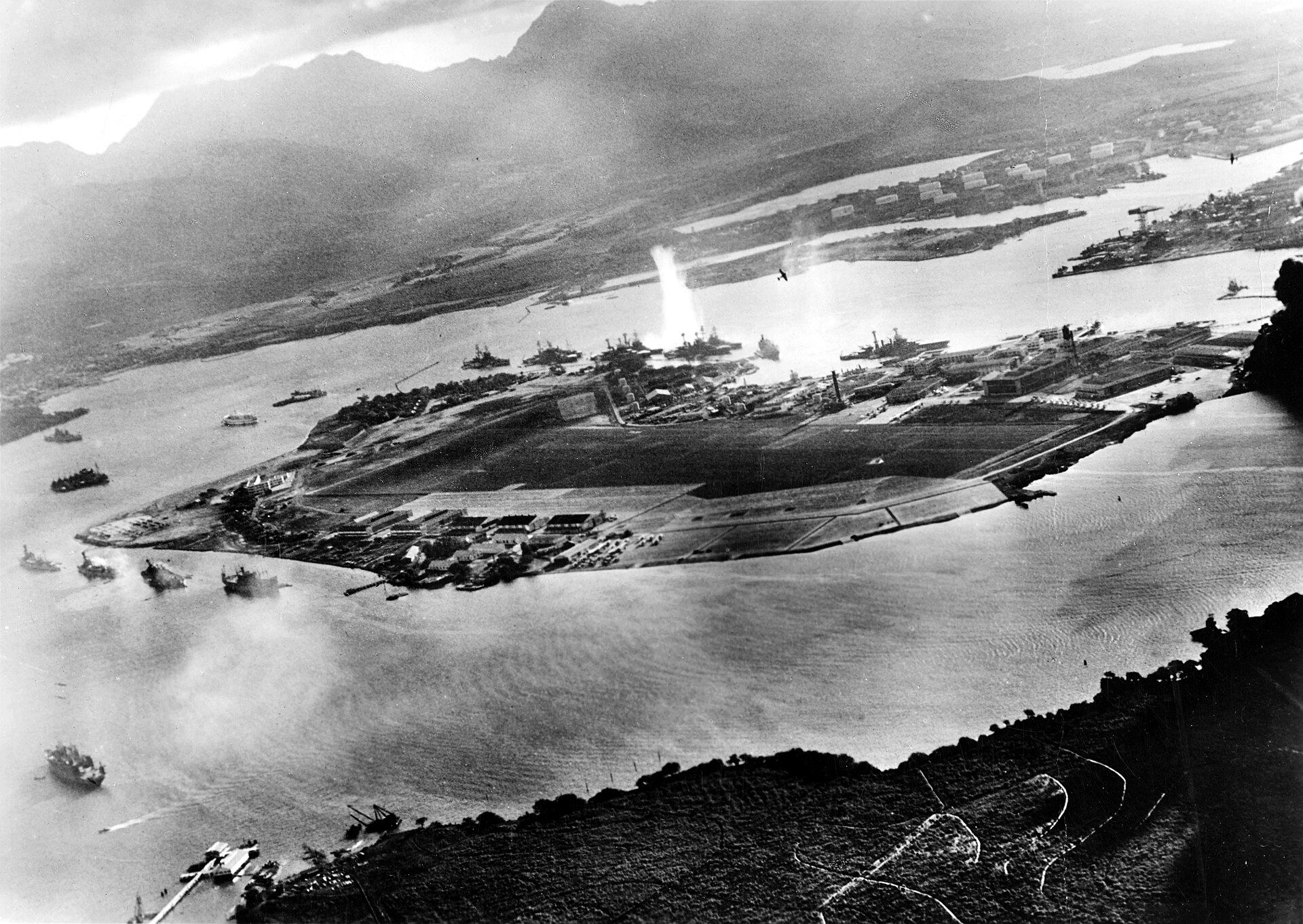
Torpedo bombers flew low across the harbour towards the battleships moored in pairs along Ford Island. Within minutes Oklahoma capsized and Arizona was destroyed when a bomb detonated her forward magazine, killing 1,177 of her crew. West Virginia and California sank at their moorings, Nevada was beached while trying to escape, and the other battleships were damaged. Airfields across Oahu were strafed and bombed, destroying most American aircraft on the ground. A second wave followed an hour later.
What was missed
In all 2,403 Americans were killed, including 68 civilians. Japan lost 29 aircraft. Yet the attack had critical gaps. The Pacific Fleet’s three aircraft carriers were away from the harbour. The fuel tank farms, submarine base and repair yards were left largely untouched. Most of the sunken battleships were later raised and returned to service.
Also on 7 December
- 1941Hitler issues the Night and Fog decree, ordering that resisters in occupied Western Europe disappear without trace.
Sources and further reading
Lead image: Battleship Row at Pearl Harbor photographed from a Japanese aircraft during the attack. Imperial Japanese Navy, Public domain, via Wikimedia Commons. See our sources and image policy.
 United Kingdom
 United States
 Soviet Union
 Germany
 Japan
 France
 Poland
 South Africa