Occupied Europe · Holocaust · Poland
The Słonim Massacre
German killing squads and local auxiliaries drive some 9,000 Jews from the ghetto of Słonim to pits outside the town and shoot them in a single day.
- Location
- Słonim (now in Belarus); killing site at Czepielów, 7 km away
- Perpetrators
- SS of Einsatzgruppe B, with Belarusian, Latvian and Lithuanian auxiliaries
- Murdered
- About 9,000 people
- Ghetto ended
- 20 August 1942
- Total deaths
- About 22,000 (Encyclopedia of the Holocaust)
- War clock
- Day 806 of 2,194
Before the war Słonim was a market town in eastern Poland where Jews made up more than half the population: 8,605 of 16,251 residents in 1931. The Soviet Union occupied it in September 1939. In late June 1941, days after the invasion of the Soviet Union, the Wehrmacht arrived.
The ghetto
The Germans quickly set up a ghetto on the far side of the Szczara River, enclosing it with barbed wire by July 1941. The Jewish council was forced to collect a ransom of two million roubles in gold, after which its members were shot. By 13 November about 7,000 skilled workers and their families remained to labour for the occupiers.
14 November
On 14 November 1941 the SS of Einsatzgruppe B carried out what they called a second sweep. Local Belarusian police dragged families from their homes, with Latvian and Lithuanian auxiliaries taking part. About 9,000 people were loaded onto lorries, driven to Czepielów, 7 kilometres from the town, and shot in prepared pits.
The killing did not end there. In June 1942 members of the ghetto underground fought back when the Germans came again, killing at least five of them; the ghetto was set on fire. Survivors escaped to the forests to fight as partisans. The last 800 Jews of Słonim were murdered on 20 August 1942.
Sources and further reading
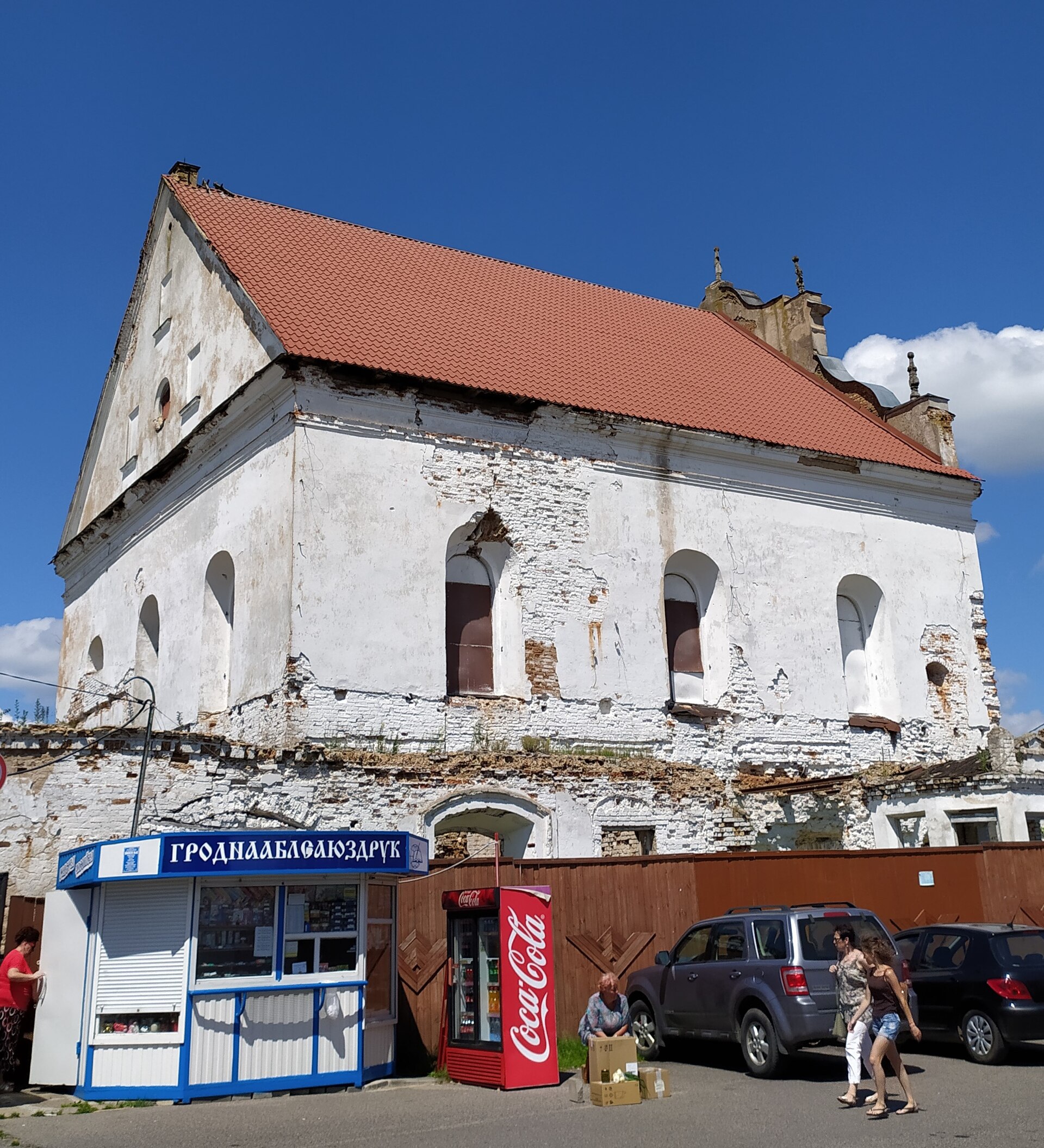
Lead image: The Great Synagogue of Słonim, Belarus. Artem.G, CC BY-SA 4.0 (licence), via Wikimedia Commons. See our sources and image policy.
 United Kingdom
 United States
 Soviet Union
 Germany
 Japan
 France
 Poland
 South Africa