Occupied Europe · Holocaust · Poland
The Warsaw Ghetto Is Sealed
German authorities close the gates on the largest Jewish ghetto in occupied Europe, trapping some 400,000 people behind walls in a small fraction of the city.
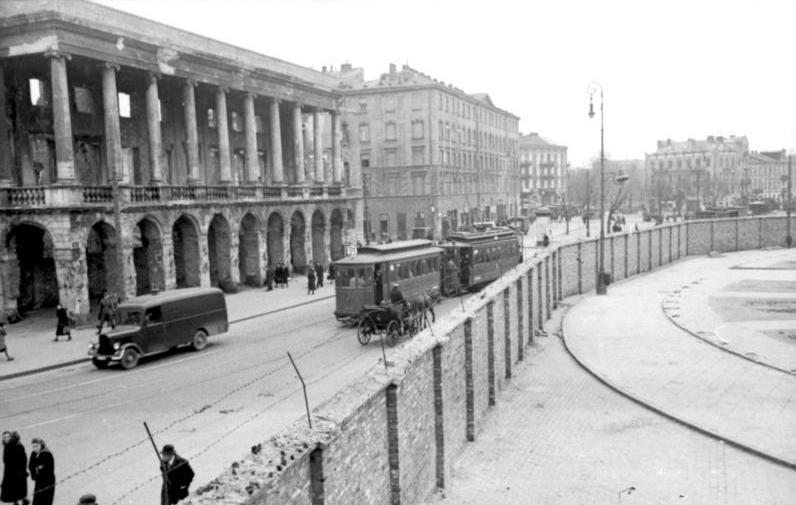
- Location
- Warsaw, German-occupied Poland
- Imposed by
- German occupation administration
- Population
- About 400,000 at closure, later over 450,000
- Area
- Roughly 3.4 km², about 2.4% of the city
- War clock
- Day 442 of 2,194
Before the war Warsaw was home to the largest Jewish community in Europe, around 350,000 people, almost a third of the city’s population. Within weeks of the German occupation in 1939 they were subjected to forced labour, confiscations, compulsory armbands and random violence. In October 1940 the German governor of the Warsaw district, Ludwig Fischer, ordered the creation of a closed Jewish residential district.
Behind the wall
Over the following weeks more than 100,000 non-Jewish Poles were moved out of the designated area and well over 100,000 Jews were forced in from other parts of the city. On 15 November 1940 the ghetto was sealed. A wall about three metres high, topped with barbed wire and broken glass, enclosed an area of roughly 3.4 square kilometres. Jews from surrounding towns were later crammed in too, and at its peak the population exceeded 450,000.
Official food rations were set at starvation level. Hunger, typhus and cold killed thousands every month, and between 1940 and mid-1942 more than 80,000 people died inside the walls. Smuggling, often by children slipping through gaps and drains, kept many alive.
Records of resistance
Life inside did not stop. People ran schools, soup kitchens, theatres and prayer houses, often illegally. The historian Emanuel Ringelblum organised a secret archive, known by the codename Oneg Shabbat, to document everything that was happening. Buried in metal boxes and milk cans, much of it was recovered after the war and remains one of the most important sources on the Holocaust.
From July 1942 the Germans deported around 300,000 of the ghetto’s inhabitants, most to be murdered at Treblinka. When the SS moved to destroy the remaining population in April 1943, Jewish fighters rose in the Warsaw Ghetto Uprising and held out for almost a month.
Also on 15 November
- 1942Church bells ring across Britain to celebrate the victory at El Alamein, for the first time since 1940.
- 1942The Naval Battle of Guadalcanal ends as the last ships of the Japanese reinforcement convoy are destroyed off the island.
Sources and further reading
Lead image: The wall of the Warsaw Ghetto. Ludwig Knobloch, CC BY-SA 3.0 de (licence), via Wikimedia Commons. See our sources and image policy.
 United Kingdom
 United States
 Soviet Union
 Germany
 Japan
 France
 Poland
 South Africa