Grand Strategy · Politics · Germany and the Soviet Union
Molotov in Berlin
Stalin’s foreign minister arrives in Berlin to discuss the Soviet Union joining the Axis. The talks fail, and within five weeks Hitler orders preparations to invade.
- Location
- Berlin, Germany
- Dates
- 12 to 14 November 1940
- Soviet delegation
- Vyacheslav Molotov, People’s Commissar for Foreign Affairs
- German side
- Adolf Hitler and Joachim von Ribbentrop
- Outcome
- No agreement; Directive No. 21 (Barbarossa) signed 18 December 1940
- War clock
- Day 439 of 2,194
Fourteen months after the Nazi-Soviet Pact, Germany and the Soviet Union were uneasy partners. The Soviets had taken eastern Poland, the Baltic states and Bessarabia; Germany now had troops in Finland and Romania. Ribbentrop proposed a meeting to settle the future, and on 12 November 1940 Vyacheslav Molotov’s train pulled into Berlin at 11:05.
A world divided
Ribbentrop offered a four-power pact with Germany, Italy and Japan that would carve up the world into spheres of influence. Germany would take Central Africa, Italy North and North-East Africa, Japan South-East Asia, and the Soviet Union would expand south towards the Indian Ocean. Hitler urged Molotov to look towards Iran and India.
Molotov wanted to talk about Europe instead. He demanded that German troops leave Finland, asked for a Soviet guarantee to Bulgaria like the one Germany had given Romania, and raised the question of the Turkish Straits. Hitler refused to let the Soviets settle with Finland by force.
The air raid shelter
That night RAF bombers came over Berlin, and Ribbentrop and Molotov continued their talks in an air raid shelter. When Ribbentrop insisted that Britain was finished, Molotov reportedly asked why, in that case, they were sitting in a shelter.
Sources and further reading
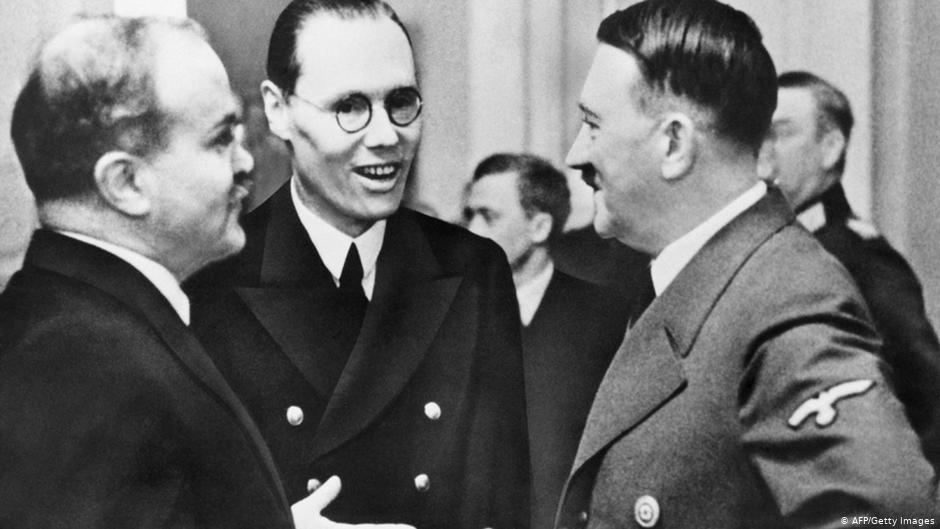
Lead image: Molotov and Hitler meet in Berlin, November 1940, with interpreter Gustav Hilger between them. Mikhail Mikhaylovich Kalashnikov, Public domain, via Wikimedia Commons. See our sources and image policy.
 United Kingdom
 United States
 Soviet Union
 Germany
 Japan
 France
 Poland
 South Africa