Western Europe · Occupation · Germany vs Vichy France
Case Anton: Germany Occupies Vichy France
Three days after the Allied landings in North Africa, German and Italian troops pour into the unoccupied zone of France, ending the fiction of Vichy independence.
- Location
- Southern France and Corsica
- Belligerents
- Germany and Italy vs Vichy France
- Operation
- Case Anton (Unternehmen Anton), 10 to 27 November 1942
- German forces
- 1st Army and 7th Army
- French resistance
- None; Vichy protested by radio
- War clock
- Day 1,168 of 2,194
Since the armistice of June 1940, France had been split in two. Germany occupied the north and the Atlantic coast, while the government of Marshal Philippe Pétain at Vichy ruled the south, the fleet and the empire. Hitler tolerated this nominally independent state chiefly to keep the French colonies and navy out of Allied hands.
The rationale collapses
Operation Torch changed everything. On 8 November 1942 American and British troops landed in French North Africa, and within days French forces there had stopped fighting them. Hitler no longer trusted Vichy to hold the empire, and preparations for a long-planned occupation of the southern zone were completed by the evening of 10 November.
Into the free zone
On 11 November the German 1st Army advanced south from the Atlantic coast along the Spanish border, while the 7th Army under Johannes Blaskowitz drove from central France towards Vichy and Toulon. By that evening German tanks had reached the Mediterranean. The Italian 4th Army occupied the French Riviera, and an Italian division landed on Corsica.
Vichy offered no armed resistance. The government limited itself to a radio broadcast protesting against the violation of the armistice, and the 50,000-strong Armistice Army was disbanded in the face of German demands. Only the naval base at Toulon, where the French fleet lay, was left for the moment outside German control.
Sources and further reading
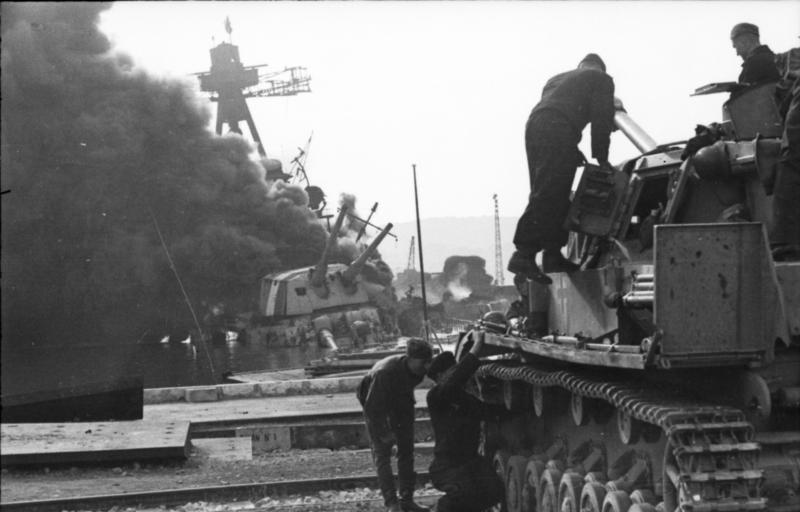
Lead image: A German tank in Toulon after the occupation of southern France, November 1942. Vennemann, Wolfgang, CC BY-SA 3.0 de (licence), via Wikimedia Commons. See our sources and image policy.
 United Kingdom
 United States
 Soviet Union
 Germany
 Japan
 France
 Poland
 South Africa