Mediterranean · War at Sea · United Kingdom vs Italy
The Raid on Taranto
Twenty-one obsolete biplanes from HMS Illustrious cripple half the Italian battle fleet in a single night, and change naval warfare for good.
- Location
- Taranto harbour, southern Italy
- Belligerents
- United Kingdom vs Italy
- Attacking force
- 21 Fairey Swordfish from HMS Illustrious
- Result
- Three battleships disabled for the loss of two aircraft
- War clock
- Day 438 of 2,194
Taranto, on the instep of the Italian boot, was the main base of the Regia Marina, and in November 1940 six Italian battleships lay at anchor there behind anti-torpedo nets and barrage balloons. The Royal Navy’s Mediterranean commander, Admiral Andrew Cunningham, wanted them out of the war. His weapon was the carrier HMS Illustrious and a force of aircraft that already looked like museum pieces.
Stringbags at night
The Fairey Swordfish was a fabric-covered biplane with an open cockpit and a top speed of little more than 220 km/h. Its crews called it the Stringbag. On the night of 11 November, 21 of them flew off Illustrious in two waves, some carrying torpedoes and others bombs and parachute flares to light up the harbour.
Flying low through heavy anti-aircraft fire and between the balloon cables, the torpedo aircraft hit the new battleship Littorio three times and struck Conte di Cavour and Caio Duilio once each. The bombers damaged a cruiser, destroyers and harbour installations. Only two Swordfish were shot down.
The morning after
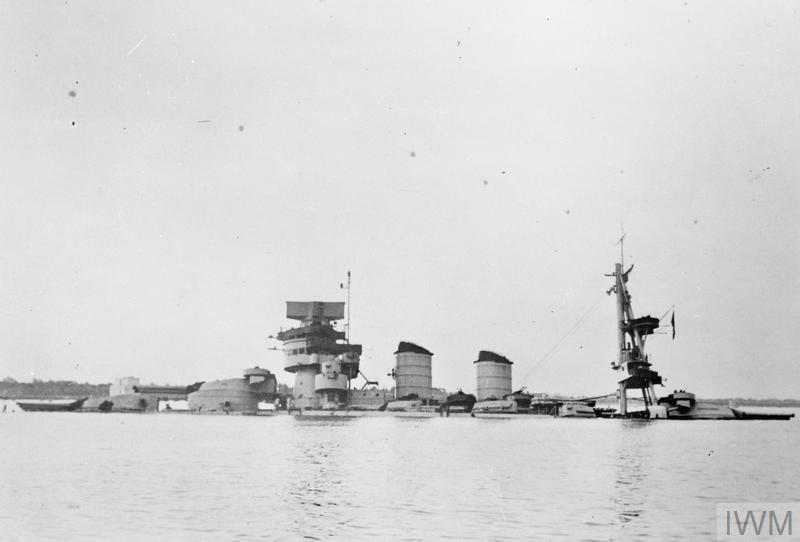
At dawn Littorio and Duilio were badly damaged and Cavour was resting on the harbour floor. She would never return to service. In one night the balance of capital ships in the Mediterranean had swung towards Britain, and the Italian fleet moved its surviving heavy units north, away from the reach of British carriers.
The raid was the first all-aircraft attack on a fleet in harbour, and navies everywhere took notice. Japanese planners studied it closely, while many in Washington continued to assume that shallow water protected the battleships at Pearl Harbor from aerial torpedoes. Taranto had already shown that assumption to be wrong.
Also on 11 November
- 1942Germany and Italy launch Case Anton, occupying the zone of southern France previously left to the Vichy regime.
- 1940The Italian air corps based in Belgium makes its largest daylight raid on Britain and loses several aircraft to RAF fighters.
Sources and further reading
Lead image: The Italian battleship Conte di Cavour settled on the bottom at Taranto after the Swordfish attack. Unknown photographer, Public domain, via Wikimedia Commons. See our sources and image policy.
 United Kingdom
 United States
 Soviet Union
 Germany
 Japan
 France
 Poland
 South Africa