Grand Strategy · Leaders and Speeches · United Kingdom
The End of the Beginning
With Rommel in retreat from El Alamein and Allied armies ashore in French North Africa, Churchill gives Britain the most carefully measured victory speech of the war.
- Location
- Mansion House, City of London
- Occasion
- The Lord Mayor’s Luncheon
- Context
- Second Battle of El Alamein and Operation Torch
- Speaker
- Winston Churchill, Prime Minister
- War clock
- Day 1,167 of 2,194
For three years Britain had measured its war in defeats and evacuations: Norway, Dunkirk, Greece, Crete, Singapore, Tobruk. On 10 November 1942, at the Lord Mayor’s Luncheon at Mansion House in London, Winston Churchill finally had something different to report, and he chose his words with unusual care.
Two pieces of good news
The first was El Alamein. On 23 October General Bernard Montgomery’s Eighth Army had opened a massive set-piece offensive against Erwin Rommel’s German-Italian army in Egypt. After twelve days of attritional fighting the Axis line broke, and from 4 November Rommel was in full retreat westward across the desert, abandoning thousands of Italian troops and much of his armour.
The second was Operation Torch. On 8 November American and British forces had landed at Casablanca, Oran and Algiers in French North Africa, the first great Anglo-American offensive of the war. Within days Vichy French resistance was collapsing, and Rommel faced the prospect of enemies to his front and his rear.
“Now this is not the end. It is not even the beginning of the end. But it is, perhaps, the end of the beginning.”Winston Churchill, Mansion House, 10 November 1942
Choosing restraint
Churchill could easily have claimed a decisive turning point. Instead he offered a phrase that celebrated victory while warning against complacency. The line landed precisely because it was measured: it accepted that the war would still be long, while telling a weary public that the strategic tide had changed.
In the same speech he made it plain that Britain intended to keep its empire, declaring that he had not become the King’s First Minister to preside over its liquidation. The remark was aimed as much at American opinion as at the audience in the room.
Five days later, on Sunday 15 November, church bells rang out across Britain to celebrate Alamein. They had been silent since 1940, reserved as the signal that invasion had begun.
Also on 10 November
- 1942Admiral François Darlan orders Vichy French forces in North Africa to cease fire against the Allied landings.
- 1938The Kristallnacht pogrom against Jews across Germany and Austria, which began the night before, runs into a second day, ten months before the war.
Sources and further reading
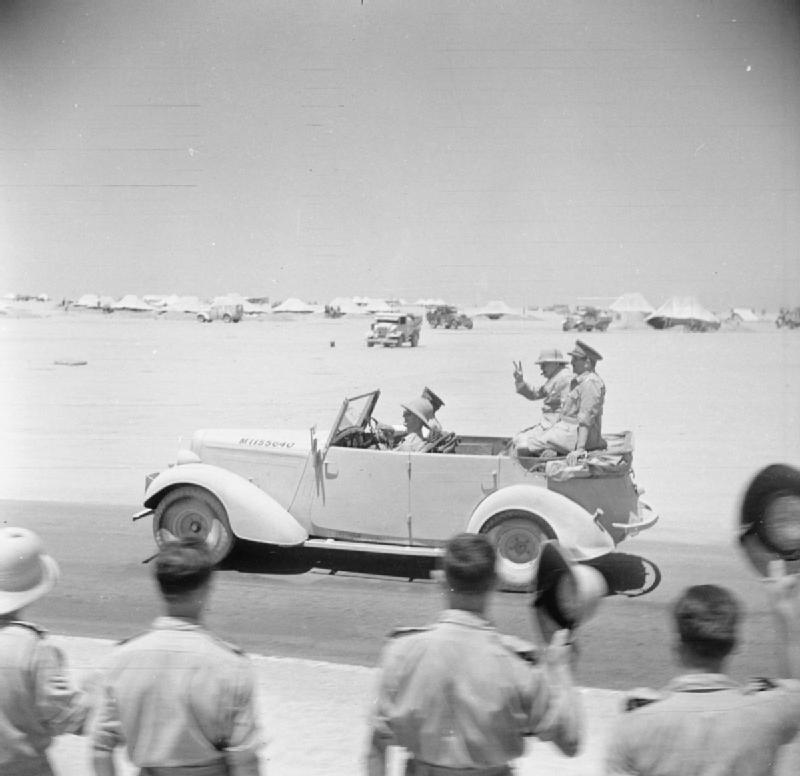
Lead image: Winston Churchill visits armoured units in Egypt, August 1942. Chetwyn (Sgt), No 1 Army Film & Photographic Unit, Public domain, via Wikimedia Commons. See our sources and image policy.
 United Kingdom
 United States
 Soviet Union
 Germany
 Japan
 France
 Poland
 South Africa