Pacific · War at Sea · United States vs Japan
The Sinking of the Battleship Kongō
In the dark waters north of Formosa, the American submarine Sealion torpedoes the veteran battleship Kongō, the only Japanese battleship sunk by a submarine in the war.
- Location
- About 55 nautical miles north-west of Keelung, Formosa (Taiwan)
- Attacker
- Submarine USS Sealion
- Torpedoes fired
- 6 at Kongō at 02:45
- Sank
- 05:24, 21 November 1944, after a magazine exploded
- Crew lost
- Over 1,200
- War clock
- Day 1,909 of 2,194
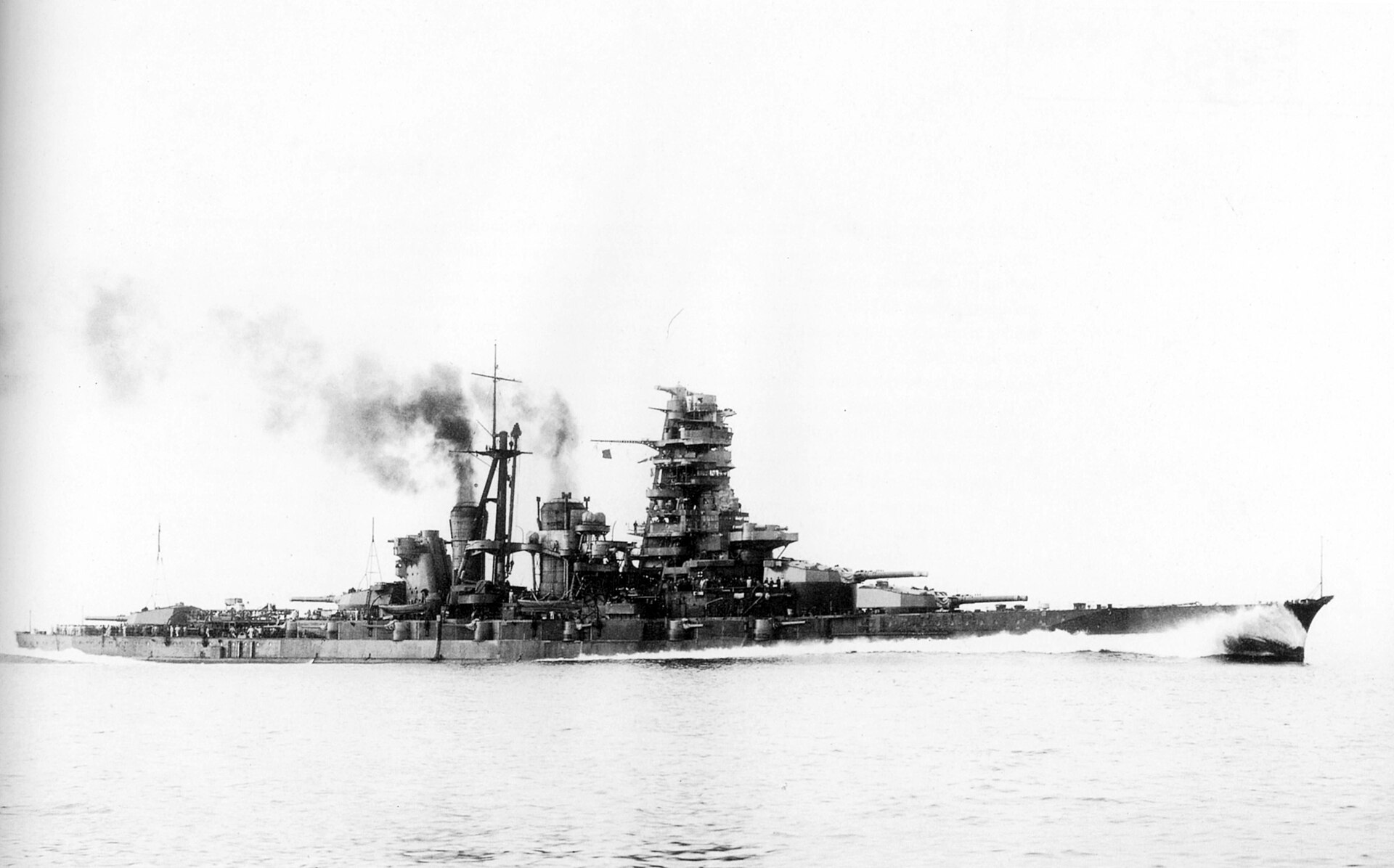
Kongō was the oldest of Japan’s battleships and one of the hardest worked. Designed and built by Vickers at Barrow-in-Furness in Britain, she was launched in 1912, the last Japanese capital ship built abroad. Rebuilt twice between the wars into a fast battleship, she supported the invasion of Malaya, raided into the Indian Ocean, bombarded Henderson Field on Guadalcanal and fought in the Battle off Samar in October 1944.
Contact after midnight
After the defeat at Leyte Gulf, Kongō was heading home to Japan with the battleships Yamato and Nagato. Shortly after midnight on 21 November 1944, the submarine USS Sealion picked up the force on radar in the Formosa Strait. At 02:45 she fired six bow torpedoes at Kongō, then three from her stern tubes at Nagato. Two torpedoes struck Kongō on the port side; another sank the destroyer Urakaze with all hands.
The magazine explodes
At first the damage seemed manageable, but with two boiler rooms flooded the battleship slowed to 11 knots and began to list. Within 15 minutes of leaving the formation she was listing 45 degrees and flooding beyond control. At 05:18 she lost all power and the order to abandon ship was given. Six minutes later, as men went over the side, her forward 14-inch magazine exploded and she sank quickly, about 55 nautical miles north-west of Keelung. More than 1,200 of her crew died, among them the commander of the Third Battleship Division and her captain.
Sources and further reading
Lead image: The battleship Kongō on sea trials off Britain, 1913. Unknown author, Public domain, via Wikimedia Commons. See our sources and image policy.
 United Kingdom
 United States
 Soviet Union
 Germany
 Japan
 France
 Poland
 South Africa