Eastern Front · Land Battles · Germany vs Soviet Union
Rostov: The First German Retreat
German panzers seize Rostov-on-Don, the gateway to the Caucasus. A week later they are thrown out, the first time in the war a major German army is forced into a strategic retreat.
- Location
- Rostov-on-Don, southern Russia
- Belligerents
- Germany vs Soviet Union
- Commanders
- Ewald von Kleist and Gerd von Rundstedt; Soviet Southern Front
- Result
- City taken on 21 November, recaptured by the Red Army on 29 November
- War clock
- Day 813 of 2,194
By November 1941 Operation Barbarossa had carried the German armies deep into the Soviet Union, but the advance was slowing everywhere. In the south, Field Marshal Gerd von Rundstedt’s Army Group South had overrun Ukraine. Its spearhead, Ewald von Kleist’s First Panzer Army, was ordered on towards Rostov-on-Don, the gateway to the Caucasus and its oilfields.
Taking the city
On 21 November German armour, including the SS Leibstandarte, fought its way into Rostov and seized the city and a bridge over the Don. German newsreels celebrated another great victory. But the panzer army was exhausted, short of fuel and winter equipment, and stretched along an exposed flank.
Thrown back
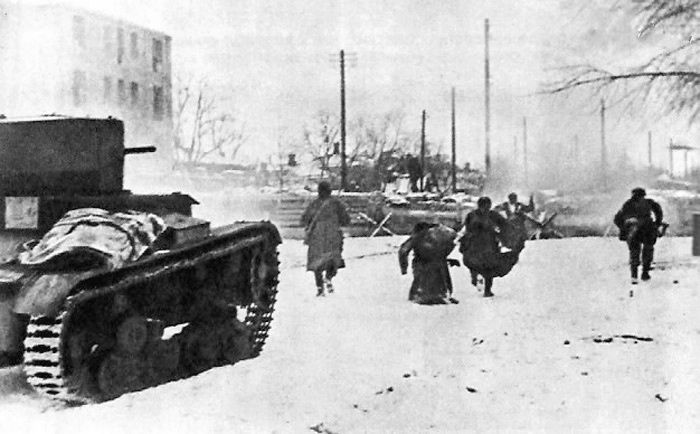
The Red Army’s Southern Front had been gathering forces to the north. As temperatures plunged, Soviet troops attacked the German flank and crossed the frozen Don to assault the city directly. Fighting in the streets was fierce. On 28 November the Germans began to pull out, and on 29 November Soviet troops retook Rostov.
Rundstedt ordered a withdrawal to a more defensible line on the Mius River. Hitler forbade it. Rundstedt replied that he could not obey and asked to be relieved, and on 1 December he was replaced. Within days Hitler, having flown to the front, accepted the withdrawal anyway.
Also on 21 November
- 1942Operation Uranus enters its third day as Soviet tank corps race to close the ring around Stalingrad.
Sources and further reading
Lead image: Fighting at Rostov-on-Don, November 1941. Unknown photographer, Public domain, via Wikimedia Commons. See our sources and image policy.
 United Kingdom
 United States
 Soviet Union
 Germany
 Japan
 France
 Poland
 South Africa