Indian Ocean · War at Sea · Australia vs Germany
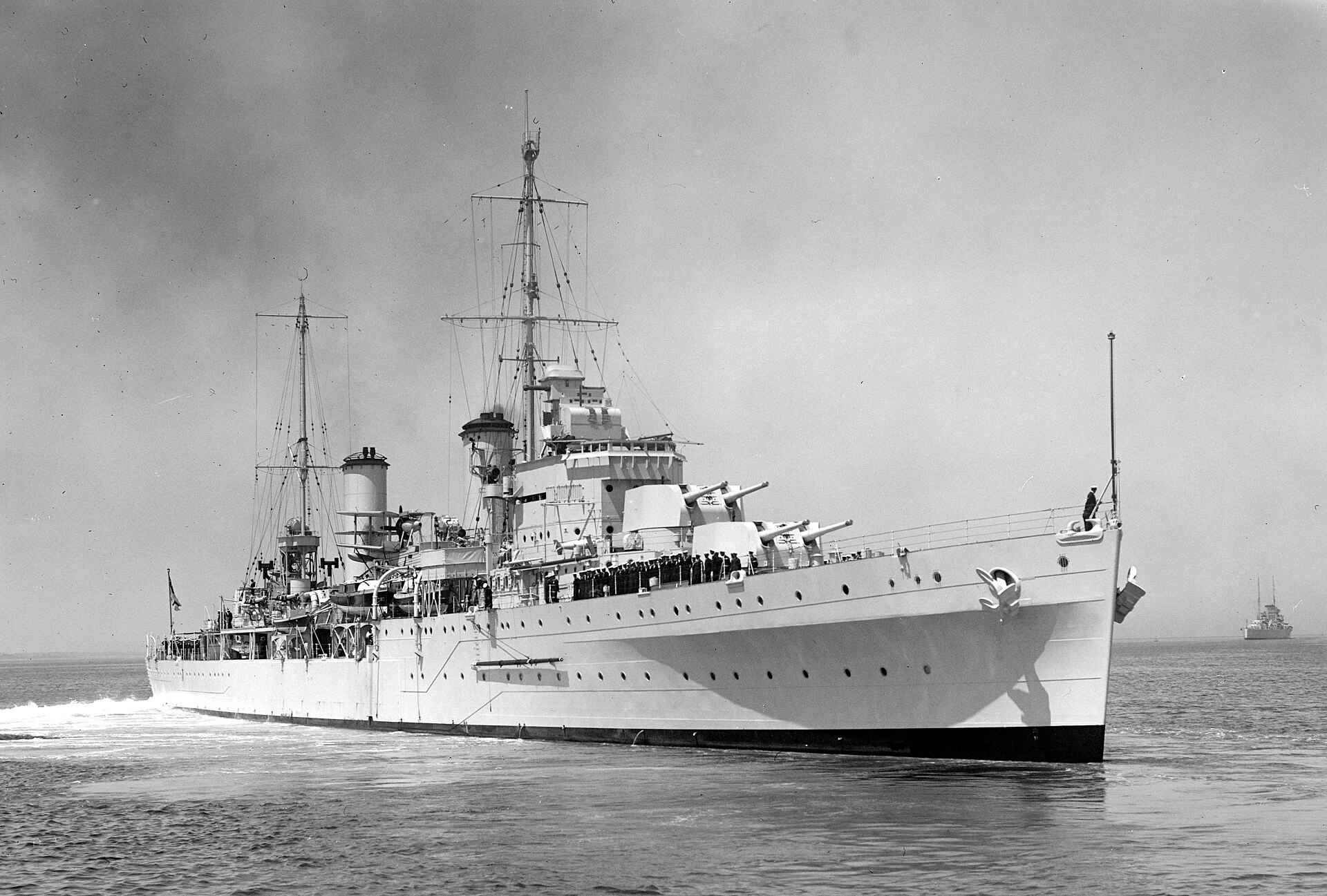
HMAS Sydney and the Kormoran
Off the coast of Western Australia, a cruiser closes in on a merchant ship that is not what it seems. Both vessels are lost, and none of Sydney’s 645 men survive.
- Location
- Indian Ocean, off Dirk Hartog Island, Western Australia
- Ships
- Light cruiser HMAS Sydney vs auxiliary cruiser Kormoran
- Commanders
- Captain Joseph Burnett; Fregattenkapitän Theodor Detmers
- Sydney’s losses
- All 645 aboard
- Kormoran’s losses
- About 80 of 399 aboard
- War clock
- Day 811 of 2,194
HMAS Sydney was the pride of the Royal Australian Navy, famous for crippling the Italian cruiser Bartolomeo Colleoni at Cape Spada in July 1940, before British destroyers finished her off. On the afternoon of 19 November 1941, returning to Fremantle along the coast of Western Australia, she sighted a merchant ship and turned to investigate.
A disguised raider
The ship was the German auxiliary cruiser Kormoran, an armed raider that had already sunk or captured eleven merchant ships. Disguised as the Dutch freighter Straat Malakka, she raised that ship’s call sign. Sydney closed in to demand her identity, ending up only about 1,300 metres off the raider’s beam, where her heavier armour and longer-range guns counted for little.
When challenged with a secret call sign she could not answer, Kormoran dropped her disguise and opened fire with guns and torpedoes. Her first salvoes wrecked Sydney’s bridge and forward turrets, and a torpedo struck her bow. Sydney’s return fire set Kormoran ablaze. The action lasted about half an hour.
Lost with all hands
Sydney drifted away, burning, and disappeared into the night. Kormoran’s crew abandoned and scuttled their ship; most of them were rescued or reached the coast in boats. Not a single one of Sydney’s 645 men was ever found alive. The wrecks were not located until March 2008, about 11 nautical miles apart and some 2,500 metres down.
Sources and further reading
Lead image: The light cruiser HMAS Sydney. Allan C. Green 1878 – 1954, Public domain, via Wikimedia Commons. See our sources and image policy.
 United Kingdom
 United States
 Soviet Union
 Germany
 Japan
 France
 Poland
 South Africa