Eastern Front · Land Battles · Soviet Union vs Axis
Operation Uranus
Out of freezing fog, Soviet armies smash through the weak Romanian flanks north and south of Stalingrad. Within four days the German Sixth Army is surrounded.
- Location
- Steppe north-west and south of Stalingrad, USSR
- Belligerents
- Soviet Union vs Germany, Romania, Italy and Hungary
- Planners
- Generals Georgy Zhukov and Aleksandr Vasilevsky
- Result
- Encirclement of the Sixth Army and part of the Fourth Panzer Army
- War clock
- Day 1,176 of 2,194
For three months the German Sixth Army under General Friedrich Paulus had fought its way into Stalingrad street by street. By November it held most of the ruined city, but the Soviet defenders still clung to strips of the riverbank along the Volga. To keep the battle going, the Germans had stripped their own flanks and left the long open steppe either side of the city to their less well-equipped Romanian allies.
The plan
Since September the Soviet high command had been secretly preparing to exploit that weakness. Generals Georgy Zhukov and Aleksandr Vasilevsky planned a double envelopment: two great pincers that would strike the Romanian armies, swing behind Stalingrad and meet near the town of Kalach on the Don. More than a million men, thousands of guns and around a thousand tanks were assembled with remarkable secrecy.
The blow falls
In the early hours of 19 November, after a massive artillery bombardment in snow and fog, the Southwestern Front and Don Front attacked the Romanian Third Army north-west of the city. The Romanians fought hard in places but lacked effective anti-tank weapons, and their line collapsed. The next day the Stalingrad Front struck the Romanian Fourth Army to the south.
Soviet tank corps raced across the frozen steppe. On 23 November the two pincers met at Sovetsky near Kalach. Inside the ring were the Sixth Army, elements of the Fourth Panzer Army and allied troops: somewhere between 250,000 and 300,000 men.
Hitler forbade a breakout. Hermann Göring promised the Luftwaffe could supply the pocket by air, a promise it could never keep. A relief attempt in December failed, and the remnants of the Sixth Army surrendered between 31 January and 2 February 1943.
Also on 19 November
- 1941The Australian cruiser HMAS Sydney and the German raider Kormoran sink each other off Western Australia. All 645 of Sydney’s crew are lost.
Sources and further reading
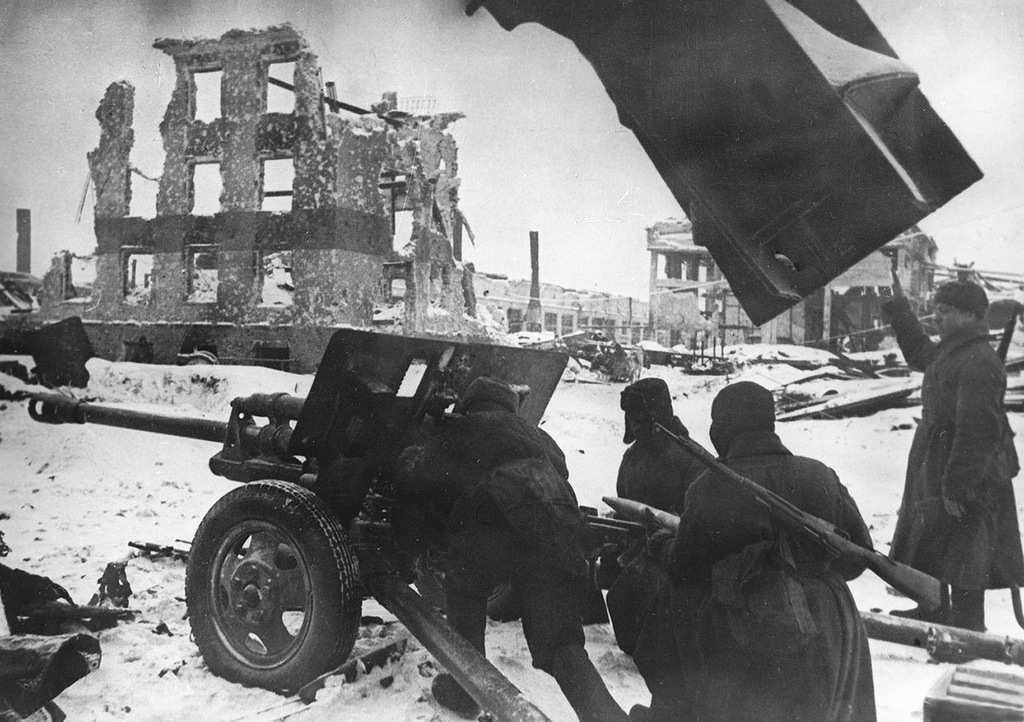
Lead image: A Soviet ZiS-3 field gun crew in action at Stalingrad, November 1942. Unknown Soviet photographer, Public domain, via Wikimedia Commons. See our sources and image policy.
 United Kingdom
 United States
 Soviet Union
 Germany
 Japan
 France
 Poland
 South Africa