Pacific · Leaders and Speeches · United States
A Date Which Will Live in Infamy
Roosevelt asks Congress for a declaration of war on Japan, as Japanese forces strike Malaya, Hong Kong, the Philippines, Guam and Wake across a front of thousands of kilometres.
- Location
- US Capitol, Washington
- Speaker
- President Franklin D. Roosevelt
- Congressional vote
- Senate 82 to 0; House 388 to 1
- Also at war
- Britain declares war on Japan the same day
- War clock
- Day 830 of 2,194
Pearl Harbor was only one part of Japan’s opening offensive. Across the international date line, on what was already 8 December in Asia, Japanese troops were landing at Kota Bharu in northern Malaya and in southern Thailand, bombing Singapore, attacking Hong Kong, and striking American air bases in the Philippines, where most of General Douglas MacArthur’s aircraft were destroyed on the ground hours after the news from Hawaii. Guam and Wake Island came under attack too.
Six minutes
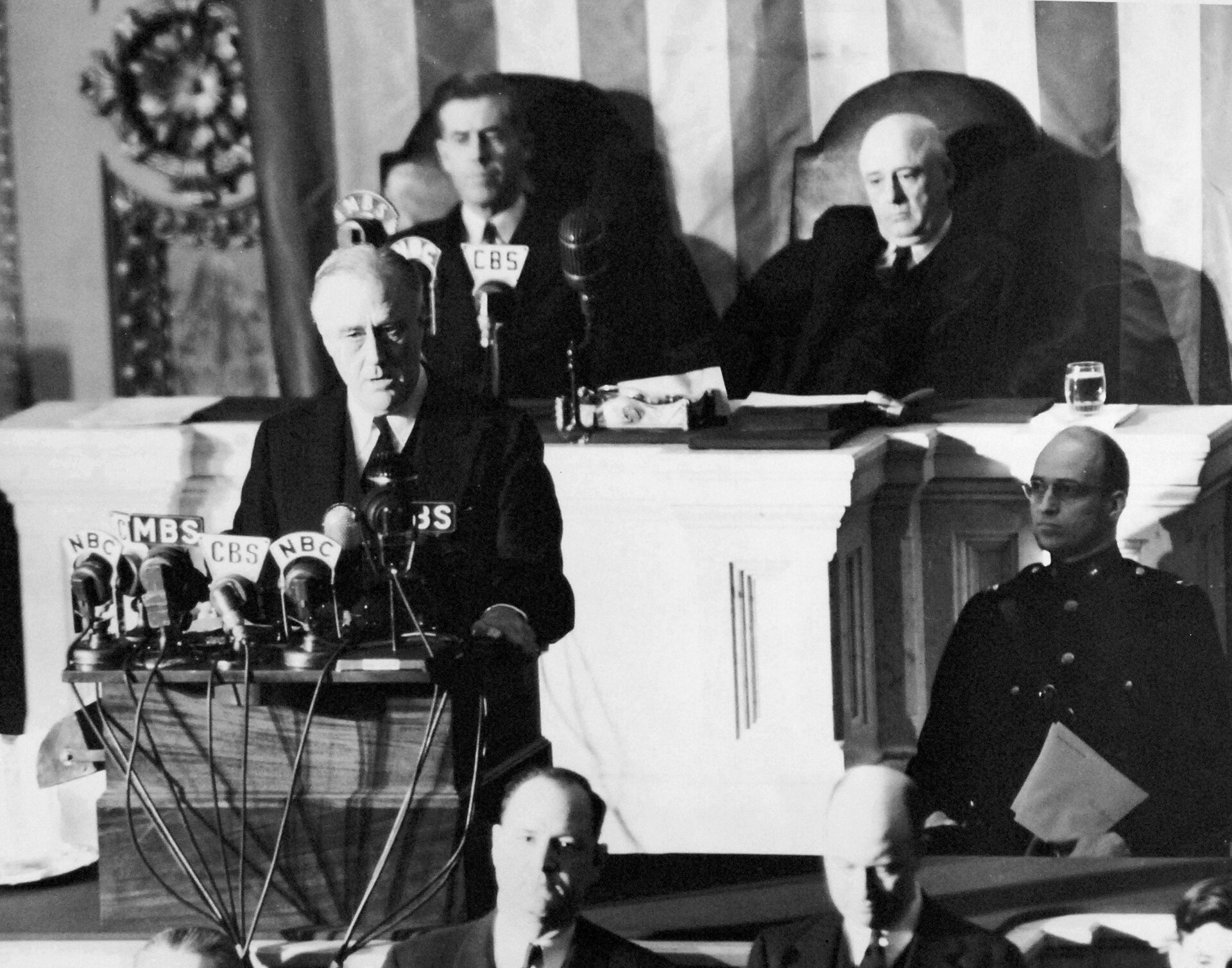
At 12:30 in Washington, Roosevelt addressed a joint session of Congress. His speech lasted about six minutes. He described 7 December as a date which will live in infamy, listed the Japanese attacks one by one, and asked Congress to declare that a state of war had existed since the attack.
“Yesterday, December 7th, 1941, a date which will live in infamy”Franklin D. Roosevelt, 8 December 1941
Within an hour Congress had voted. The Senate was unanimous; in the House, Jeannette Rankin of Montana, who had also voted against war in 1917, cast the only vote against. Roosevelt signed the declaration that afternoon.
Britain and the Commonwealth
Britain declared war on Japan the same day, ahead of the United States, and Commonwealth governments followed. China, at war with Japan since 1937, formally declared war on Japan, Germany and Italy the next day.
Also on 8 December
- 1941Japanese troops land at Kota Bharu in Malaya, opening the campaign that will end with the fall of Singapore.
Sources and further reading
Lead image: Franklin D. Roosevelt delivers the Day of Infamy speech to Congress, 8 December 1941. US Government, Public domain, via Wikimedia Commons. See our sources and image policy.
 United Kingdom
 United States
 Soviet Union
 Germany
 Japan
 France
 Poland
 South Africa