Mediterranean · Air War · Allies vs Germany
The Bombing of Monte Cassino Abbey
Allied bombers destroy the ancient Benedictine abbey above Cassino, believing the Germans are using it. They are not, until the ruins hand them a fortress.
- Date
- 15 February 1944
- Aircraft
- 142 B-17s, 47 B-25s, 40 B-26s
- Bombs
- About 1,150 tonnes
- Killed in the abbey
- About 230 Italian civilians
- Request passed on by
- Lt Gen Bernard Freyberg, New Zealand Corps
- War clock
- Day 1,629 of 2,194
The abbey of Monte Cassino, founded by St Benedict in the sixth century, stood on a mountain above the town of Cassino, commanding the Liri valley and the road to Rome. By early 1944 it looked down on the Gustav Line, where the Allied advance in Italy had stalled.
The decision
Field Marshal Albert Kesselring had ordered his troops to keep out of the abbey and told the Vatican and the Allies so. But Allied commanders facing the mountain were convinced German observers were inside. The acting commander of the 4th Indian Division asked for it to be bombed, and on 12 February Lieutenant General Bernard Freyberg of the New Zealand Corps passed the request on. Air planners turned it into a massive raid.
The raid
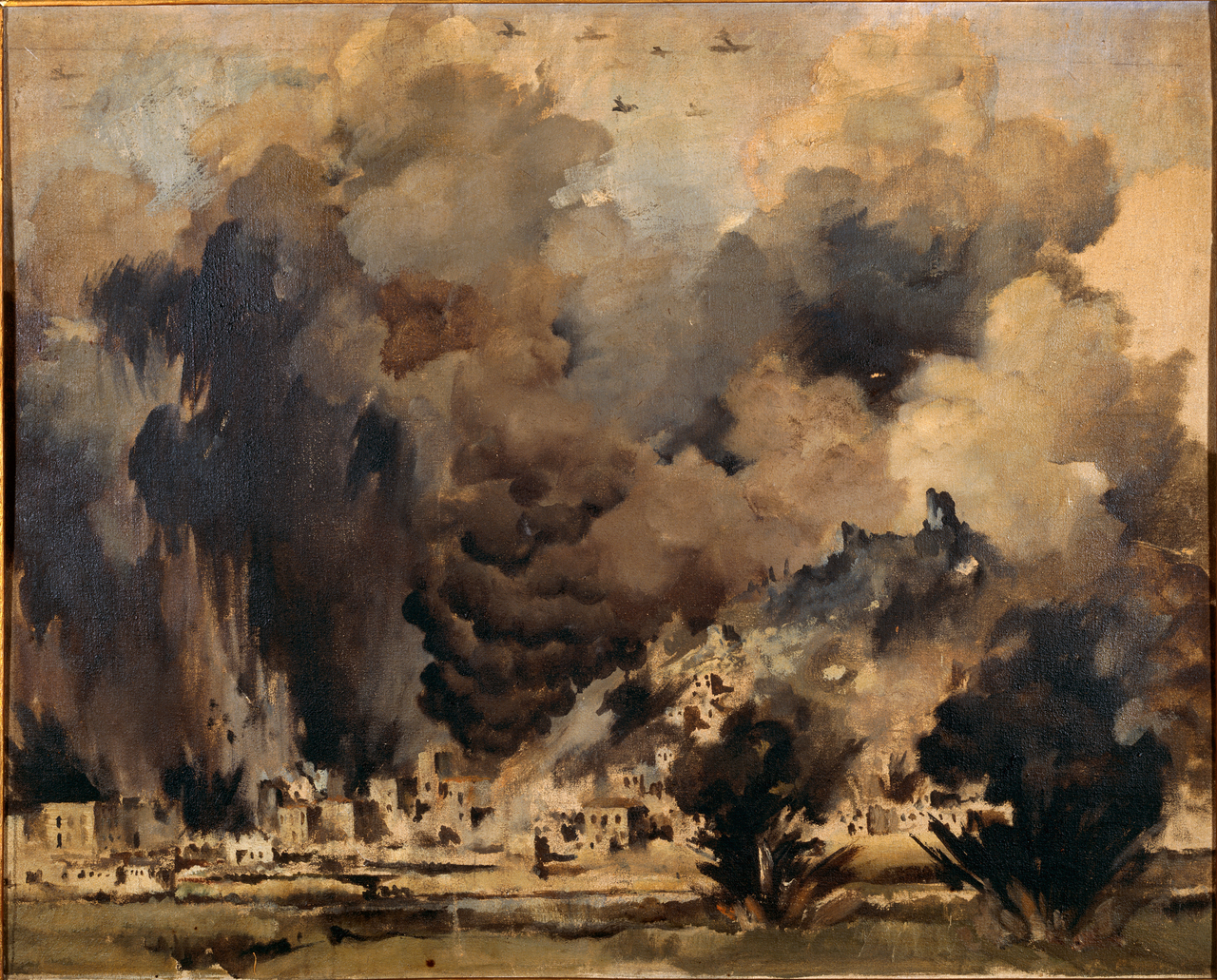
On the morning of 15 February, 142 B-17 heavy bombers, followed by 47 B-25 and 40 B-26 medium bombers, dropped about 1,150 tonnes of high explosive and incendiaries, and artillery joined in. The abbey was reduced to rubble. The only people known to have been killed inside were about 230 Italian civilians who had taken shelter there.
German paratroopers then moved into the ruins and turned them into a fortress. The ground attacks that followed failed and were called off on 18 February.
Sources and further reading
Lead image: Air raid at Monte Cassino, a painting by the New Zealand war artist Peter McIntyre. Peter McIntyre (Archives New Zealand), CC BY-SA 2.0 (licence), via Wikimedia Commons. See our sources and image policy.
 United Kingdom
 United States
 Soviet Union
 Germany
 Japan
 France
 Poland
 South Africa