Pacific · War at Sea · United States vs Japan
Wake Island Turns Back the Invasion
Holding their fire until the last moment, the Marines on Wake Island sink a Japanese destroyer with their coastal guns, and their last fighters sink another, forcing the invasion fleet to turn back.
- Location
- Wake Island, central Pacific
- Japanese commander
- Rear Admiral Sadamichi Kajioka
- US commanders
- Commander Winfield Cunningham; Major James Devereux
- Japanese ships sunk
- Destroyers Hayate and Kisaragi
- Japanese casualties
- 407
- War clock
- Day 833 of 2,194
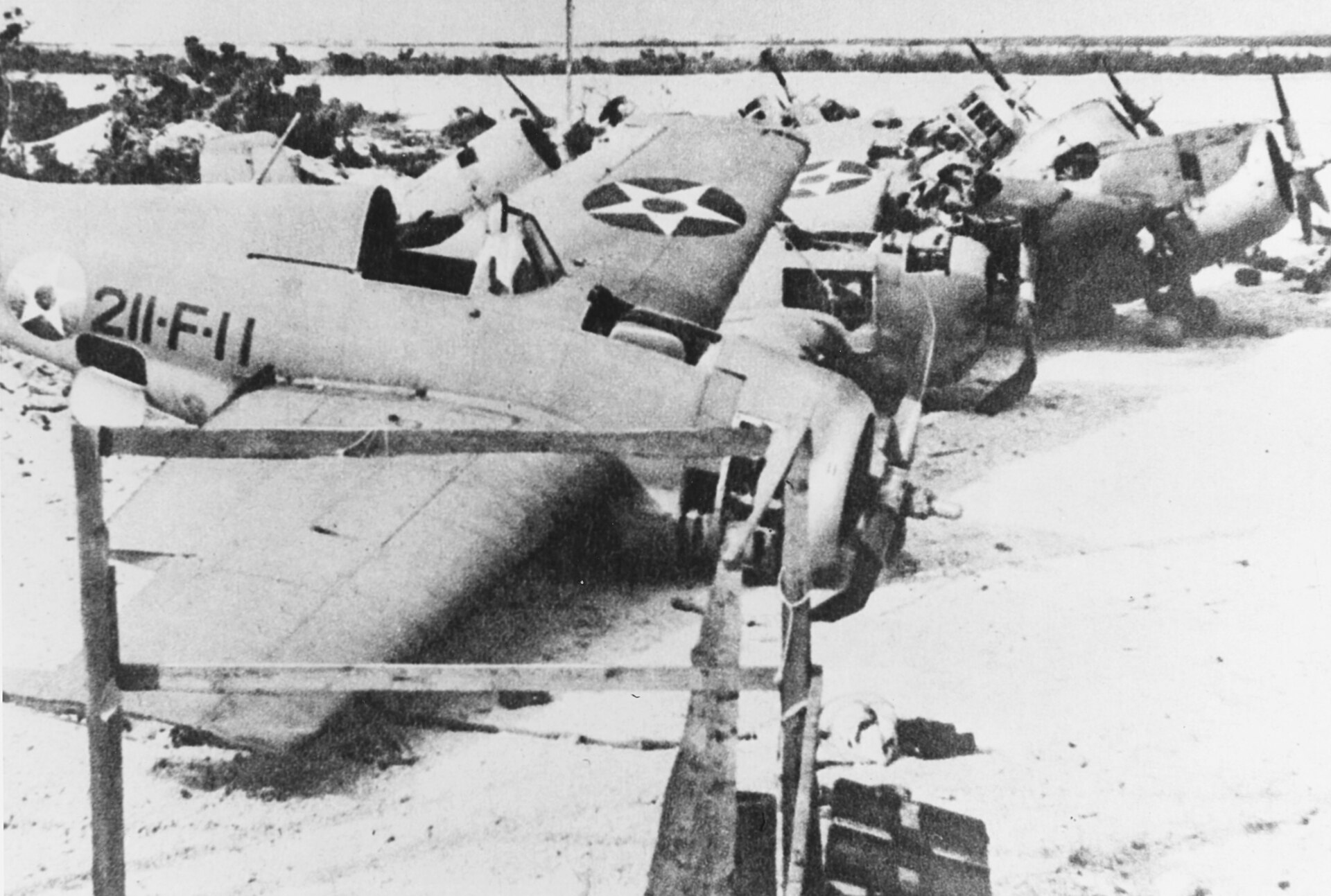
Wake Island, a tiny atoll between Hawaii and Guam, was attacked from the air on 8 December 1941, hours after Pearl Harbor. Its garrison of Marines, with civilian contractors, had six 5-inch coastal guns taken from the old battleship Texas and a handful of Wildcat fighters of Marine squadron VMF-211.
Hold your fire
Before dawn on 11 December, Rear Admiral Sadamichi Kajioka arrived with three light cruisers, six destroyers and transports carrying 450 naval landing troops. Commander Winfield Cunningham ordered the guns to hold their fire until the ships came in close. Then the Marines opened up. Battery L on Peale islet hit the destroyer Hayate in her magazines at about 3,700 metres; she exploded and sank within two minutes, the first Japanese surface warship sunk in the war.
The Wildcats strike
The four remaining Wildcats attacked the retreating ships. A bomb struck the destroyer Kisaragi, which blew up and sank with nearly all hands. Captain Henry Elrod, one of the pilots, was later awarded the Medal of Honor posthumously for his part in the defence of Wake. The Japanese recorded 407 casualties, and Kajioka withdrew without landing a single man.
Sources and further reading
Lead image: Wrecked Wildcat fighters of VMF-211 by the Wake Island airstrip, photographed after the Japanese capture of the island. Unknown Japanese photographer, Public domain, via Wikimedia Commons. See our sources and image policy.
 United Kingdom
 United States
 Soviet Union
 Germany
 Japan
 France
 Poland
 South Africa