Grand Strategy · Politics · Germany vs United States
Germany Declares War on America
Under no treaty obligation to do so, Hitler declares war on the United States. Roosevelt no longer has to persuade Americans to fight Germany.
- Declared by
- Germany and Italy
- Announced
- Hitler’s speech to the Reichstag, Berlin
- US response
- Congress declares war on both the same day
- Effect
- The European and Pacific wars become one
- War clock
- Day 833 of 2,194
After Pearl Harbor, Roosevelt faced a dilemma. Congress had declared war on Japan, but many Americans saw Germany as the greater threat, and there was no clear basis for war against it. The Tripartite Pact obliged Germany to help Japan only if Japan were attacked, not if it attacked first.
Hitler’s choice
Hitler made the choice for him. On 11 December 1941 the German Foreign Minister, Joachim von Ribbentrop, handed the declaration to the American chargé d’affaires in Berlin, and Hitler announced it in a long speech to the Reichstag. Italy followed the same day. Hitler believed the United States was already waging an undeclared war on Germany in the Atlantic, wanted his U-boats unleashed against American shipping, and underestimated American power.
Congress replies
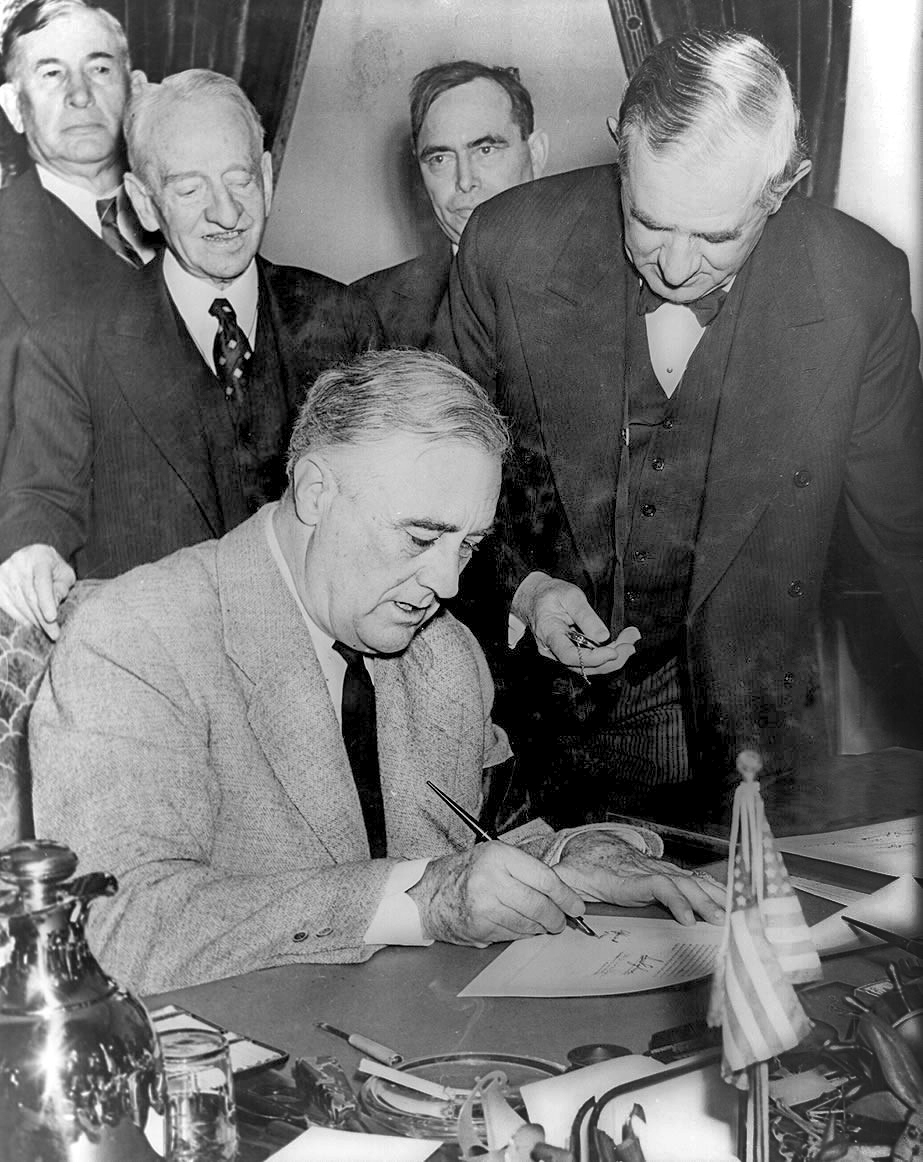
In Washington Roosevelt asked Congress to recognise a state of war with Germany and Italy, and it did so that afternoon without a vote against. Within weeks the Allies confirmed the strategy of defeating Germany first. In January 1942 U-boats began a devastating campaign off the American east coast.
Also on 11 December
- 1941Japanese invasion of Wake Island is beaten off by the US Marine garrison and coastal guns, the first Japanese amphibious setback of the war.
Sources and further reading
Lead image: Franklin D. Roosevelt signs the declaration of war against Germany, 11 December 1941. Farm Security Administration/Office of War Information, Public domain, via Wikimedia Commons. See our sources and image policy.
 United Kingdom
 United States
 Soviet Union
 Germany
 Japan
 France
 Poland
 South Africa