Grand Strategy · Science · United States
The First Nuclear Chain Reaction
Under the stands of a Chicago football field, Enrico Fermi’s team withdraws a control rod and achieves the world’s first self-sustaining nuclear chain reaction.
- Location
- Under the West Stands of Stagg Field, University of Chicago
- Led by
- Enrico Fermi
- Critical
- 15:25, 2 December 1942
- Built from
- About 360 short tons of graphite and over 50 short tons of uranium and uranium oxide
- Power
- About 0.5 watts for about 4.5 minutes
- War clock
- Day 1,189 of 2,194
In 1942 the United States set out to build an atomic bomb before Germany could. The first question was whether a nuclear chain reaction, in which splitting uranium atoms release neutrons that split further atoms, could be made to sustain itself and be controlled. The man chosen to find out was Enrico Fermi, the Italian Nobel laureate who had left Fascist Italy in 1938.
A pile of graphite
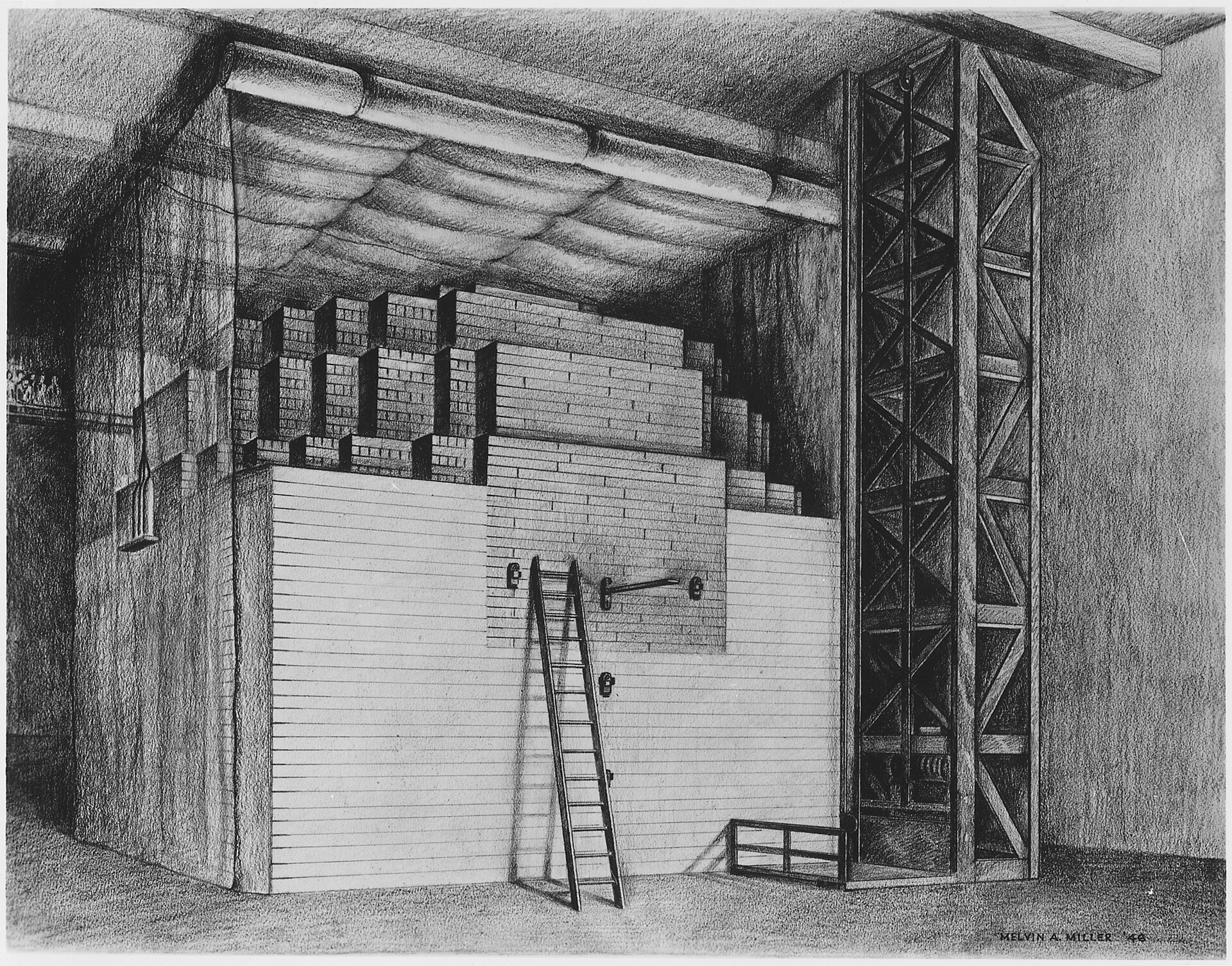
Fermi’s team built their reactor in a former rackets court beneath the west stands of Stagg Field, the University of Chicago’s disused football stadium. Chicago Pile-1 was literally a pile: some 45,000 graphite blocks, weighing around 360 short tons, stacked in layers with lumps of uranium metal and uranium oxide embedded among them. Cadmium control rods absorbed neutrons to hold the reaction in check.
15:25
On the morning of 2 December 1942, with 49 scientists watching, Fermi began the experiment, ordering the control rod withdrawn a little at a time and calculating each step on his slide rule. After a break for lunch the work resumed, and at 15:25 he announced that the pile had gone critical. The chain reaction ran for about four and a half minutes at roughly half a watt before the rods were pushed back in.
Arthur Compton telephoned James Conant of the National Defense Research Committee with a coded message.
The Italian navigator has landed in the New World.Arthur Compton to James Conant, 2 December 1942
Sources and further reading
Lead image: Chicago Pile-1, the first nuclear reactor, built under the stands of Stagg Field at the University of Chicago. Melvin A. Miller of the Argonne National Laboratory, Public domain, via Wikimedia Commons. See our sources and image policy.
 United Kingdom
 United States
 Soviet Union
 Germany
 Japan
 France
 Poland
 South Africa