Pacific · Intelligence · Soviet Union vs Japan
The Execution of Richard Sorge
In a Tokyo prison, the Soviet master spy who warned Moscow of Barbarossa and learned that Japan would not attack the Soviet Union goes to the gallows.
- Location
- Sugamo Prison, Tokyo, Japan
- Born
- 4 October 1895, Sabunchi, near Baku
- Cover
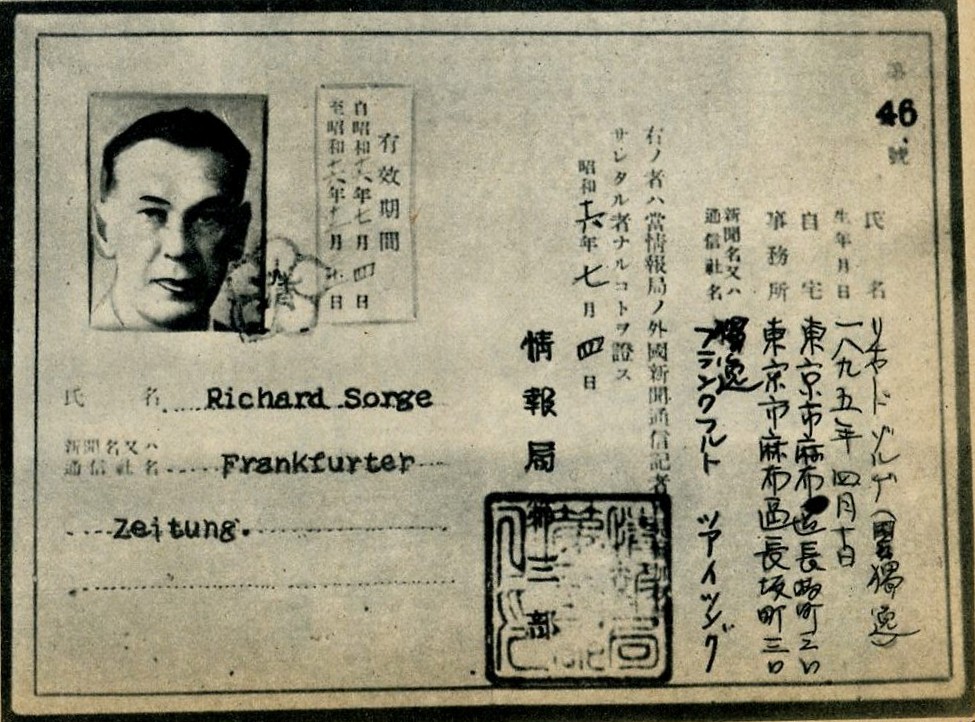
- Japan correspondent of the Frankfurter Zeitung
- Arrested
- 18 October 1941
- Executed
- 10:20, 7 November 1944
- War clock
- Day 1,895 of 2,194
Richard Sorge was born in 1895 near Baku to a German father and a Russian mother, served in the German army in the First World War and became a convinced communist. Working for Soviet military intelligence, he arrived in Japan in September 1933 as correspondent for the Frankfurter Zeitung. A hard-drinking, charming Nazi Party member, he won the confidence of the German embassy and of Ambassador Eugen Ott.
The Tokyo ring
Sorge’s network included the Japanese journalist Hotsumi Ozaki, who had access to circles close to Prime Minister Fumimaro Konoe, the radio operator Max Clausen, Branko Vukelić and Miyagi Yotoku. On 30 May 1941 Sorge reported that Germany would attack the Soviet Union in the latter part of June, and on 20 June that war was inevitable. Stalin did not act on the warnings.
His most valuable work followed. On 25 August 1941 he reported that Japan’s High Command had decided not to make war on the Soviet Union that year, and on 14 September that the danger of a Japanese attack had passed. The intelligence supported Moscow’s decision to move divisions from the Far East to the west as German armies neared the capital.
Arrest and death
Japanese counter-intelligence closed in, and Sorge was arrested in Tokyo on 18 October 1941. Moscow never acknowledged him. After three years in prison he was hanged at Sugamo Prison at 10:20 on 7 November 1944, the anniversary of the Bolshevik Revolution; Ozaki had been executed earlier the same day.
Sources and further reading
Lead image: Richard Sorge’s press pass as a German correspondent in Japan. Cabinet Information Bureau, Japan, Public domain, via Wikimedia Commons. See our sources and image policy.
 United Kingdom
 United States
 Soviet Union
 Germany
 Japan
 France
 Poland
 South Africa