Occupied Europe · Mass Murder · Soviet Union and Poland
The Katyn Order
Stalin and the Politburo approve a proposal from the head of the NKVD: thousands of Polish officers and other prisoners are to be shot.
- Proposal by
- Lavrentiy Beria, head of the NKVD
- Approved
- 5 March 1940, by Stalin and the Politburo
- Victims
- Around 22,000 Polish officers, police and others
- Main killing sites
- Katyn forest, Kalinin and Kharkiv
- War clock
- Day 187 of 2,194
When the Red Army invaded eastern Poland in September 1939, it captured hundreds of thousands of Polish soldiers. Officers, police officers, border guards and others considered dangerous were separated and held in special camps. Many officers were reservists: doctors, lawyers, teachers and engineers, a large part of Poland’s educated class.
The decision
In early March 1940 Lavrentiy Beria, head of the Soviet security police, sent Stalin a proposal to shoot the prisoners without trial, describing them as committed enemies of Soviet power. On 5 March the Politburo approved it. The killings were carried out in April and May 1940 at the Katyn forest near Smolensk, at Kalinin and at Kharkiv, among other places.
The lie
In April 1943 Germany announced the discovery of mass graves at Katyn. The Soviet Union blamed Germany, and the Polish government in exile’s call for an inquiry led Stalin to break off relations. For decades the Soviet version was maintained. Only in 1990 did the Soviet Union admit responsibility.
Sources and further reading
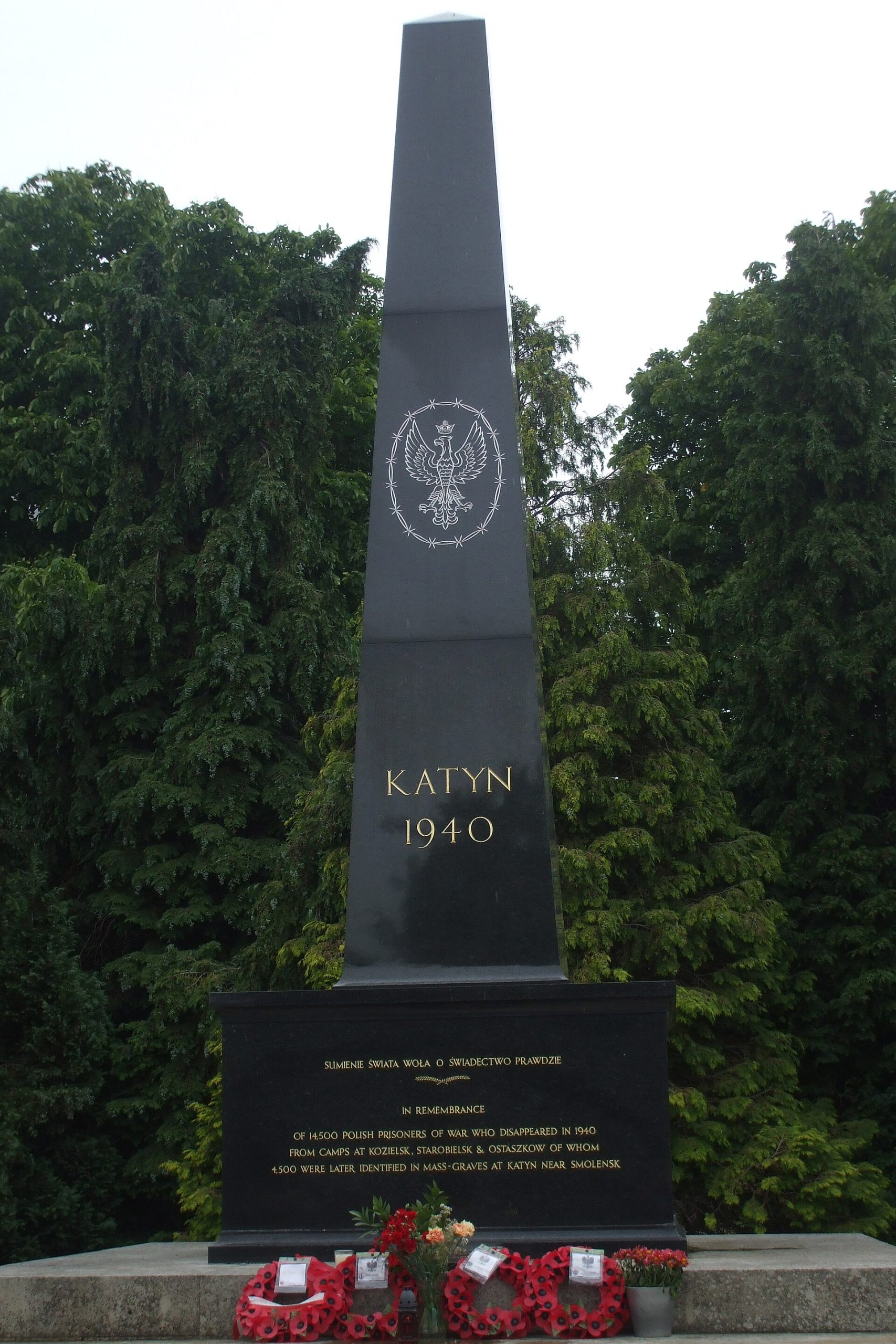
Lead image: The Katyn memorial at Gunnersbury Cemetery, London. Phillip Perry, CC BY-SA 2.0 (licence), via Wikimedia Commons. See our sources and image policy.
 United Kingdom
 United States
 Soviet Union
 Germany
 Japan
 France
 Poland
 South Africa