Northern Europe · Commando Raid · Britain and Norway vs Germany
The Lofoten Raid
British commandos and Norwegian troops land unopposed in the Lofoten Islands, blow up fish oil factories and sail home with prisoners, volunteers and a secret prize.
- Operation
- Claymore
- Location
- Lofoten Islands, northern Norway
- Forces
- No. 3 and No. 4 Commando, Royal Navy, Norwegian troops
- Hidden prize
- Spare Enigma cipher rotors
- War clock
- Day 551 of 2,194
In early 1941 Britain had few ways to strike at Germany on land. The newly formed Commandos were meant to raid the occupied coast. The Lofoten Islands, far north in Norway, produced fish oil used to make glycerine for explosives, and they were lightly defended.
The raid
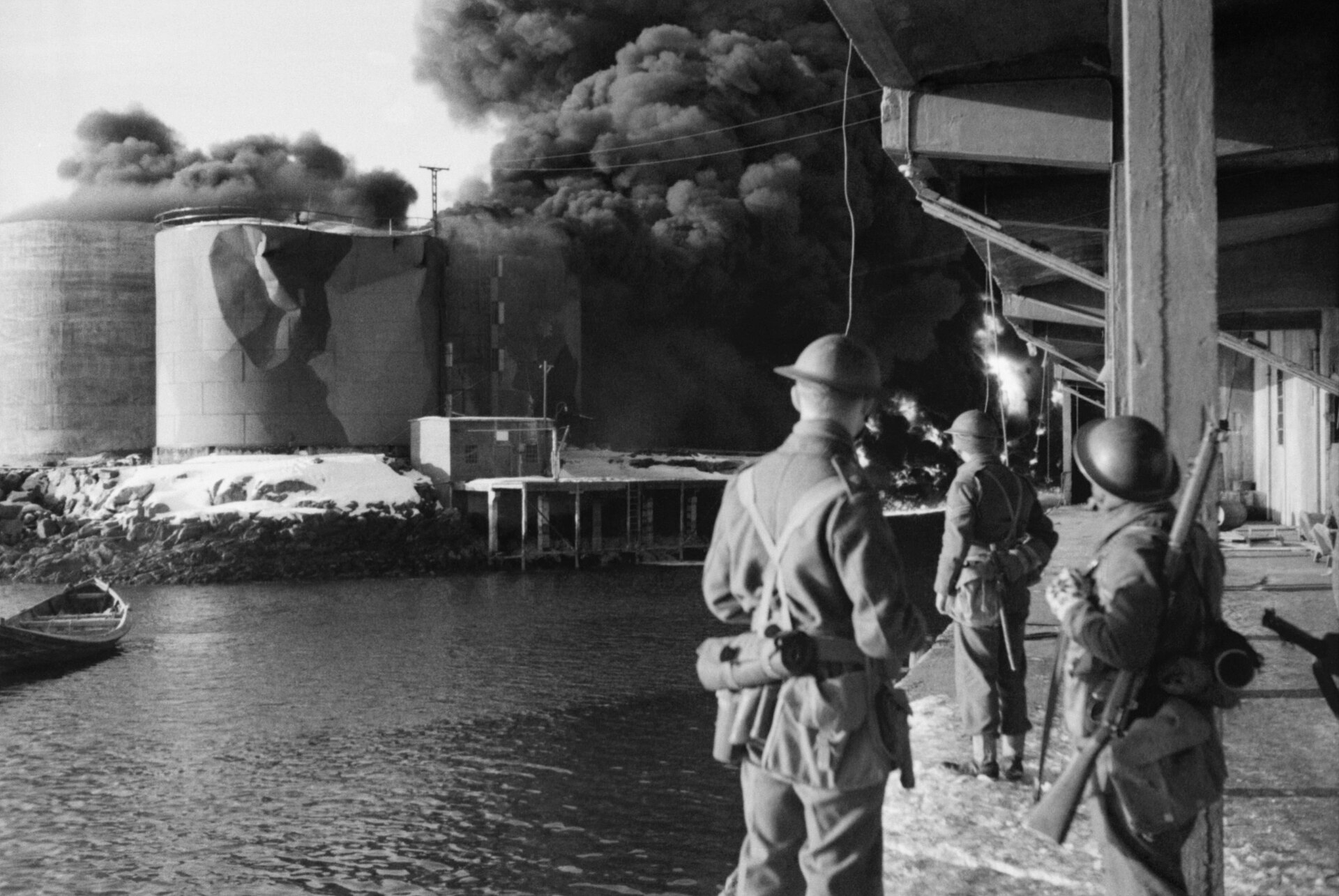
On 4 March 1941 the commandos and a group of Norwegian soldiers landed at four harbours. There was almost no resistance. They destroyed fish oil factories and storage tanks and sank around ten ships. They took over 200 German prisoners along with a number of Norwegian collaborators. More than 300 Norwegians volunteered to leave with them to join the Free Norwegian forces in Britain.
The Krebs
During the raid, the destroyer HMS Somali disabled the German armed trawler Krebs. A boarding party found spare rotor wheels for the naval Enigma cipher machine and related documents, which were sent to Bletchley Park.
Sources and further reading
Lead image: Commandos during the raid on the Lofoten Islands, 4 March 1941. Capt Tennyson d’Eyncourt, War Office official photographer, Public domain, via Wikimedia Commons. See our sources and image policy.
 United Kingdom
 United States
 Soviet Union
 Germany
 Japan
 France
 Poland
 South Africa