Western Europe · War at Sea · Belgium, Canada and United Kingdom
The First Convoy Reaches Antwerp
Twelve weeks after the city fell, the first Allied convoy sails up the cleared Scheldt into Antwerp, led by the Canadian-built freighter Fort Cataraqui.
- Location
- Port of Antwerp, Belgium
- Lead ship
- Fort Cataraqui, a Canadian-built freighter
- Minesweeping
- Ordered 4 November, completed 28 November 1944
- Battle of the Scheldt
- 2 October to 8 November 1944
- Supplies landed
- 2.5 million tons, November 1944 to April 1945
- War clock
- Day 1,916 of 2,194
British troops captured Antwerp on 4 September 1944, the first port the Allies had taken in near perfect condition. It was one of the largest ports in Europe, close to the German frontier, exactly what the Allied armies needed. Yet for almost three months not a single cargo could be landed there, because the Germans still held the banks of the Scheldt estuary between the city and the sea.
Clearing the Scheldt
The First Canadian Army, under the acting command of Lieutenant-General Guy Simonds, spent October and early November clearing both banks of the river, ending with the assault on Walcheren. The battle cost the Allies heavy casualties, 6,367 of them Canadian, and took more than 41,000 German prisoners.
Even then the river was choked with mines. Admiral Sir Bertram Ramsay ordered the sweeping on 4 November, and from 20 November Royal Navy minesweepers worked along the channel, a task not completed until 28 November.
The ships come in
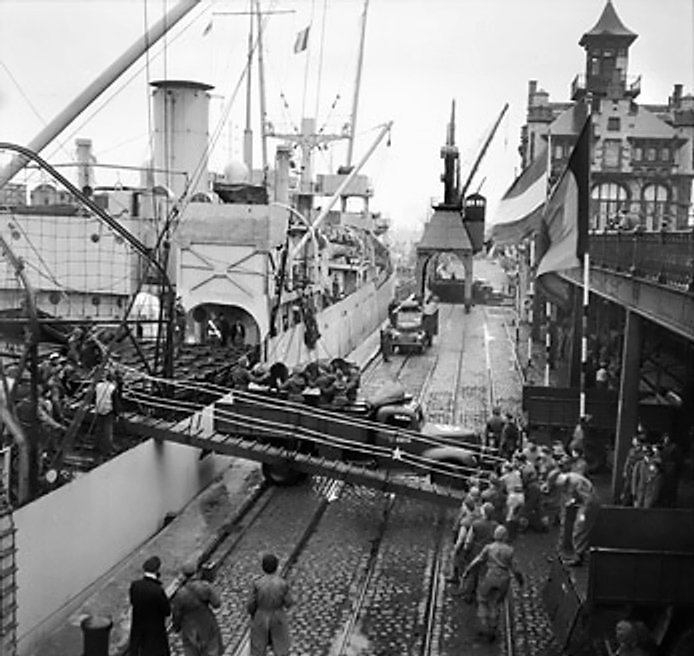
On 28 November 1944 the first convoy arrived at Antwerp, led by Fort Cataraqui, a merchant ship built in Canada. Cranes that had stood idle since September began to swing again, and the long supply line from the Normandy beaches was finally cut short.
Sources and further reading
Lead image: The Canadian-built freighter Fort Cataraqui in the port of Antwerp. Unknown author, Public domain, via Wikimedia Commons. See our sources and image policy.
 United Kingdom
 United States
 Soviet Union
 Germany
 Japan
 France
 Poland
 South Africa