Western Europe · Home Front · United Kingdom
The Fauld Explosion
Deep under the Staffordshire countryside, thousands of tonnes of RAF bombs blow up in one of the largest non-nuclear explosions in history.
- Location
- RAF Fauld, near Hanbury, Staffordshire
- Time
- 11:11, 27 November 1944
- Explosives
- 3,500 to 4,000 tonnes
- Crater
- About 30 m deep and up to 307 m wide
- Deaths
- At least 70
- War clock
- Day 1,915 of 2,194
RAF Fauld was an underground bomb store in old gypsum mines beneath the Staffordshire countryside, near the village of Hanbury. By late 1944 it held vast quantities of high-explosive bombs and ammunition, handled by RAF personnel, civilian workers and Italian prisoners of war.
11:11
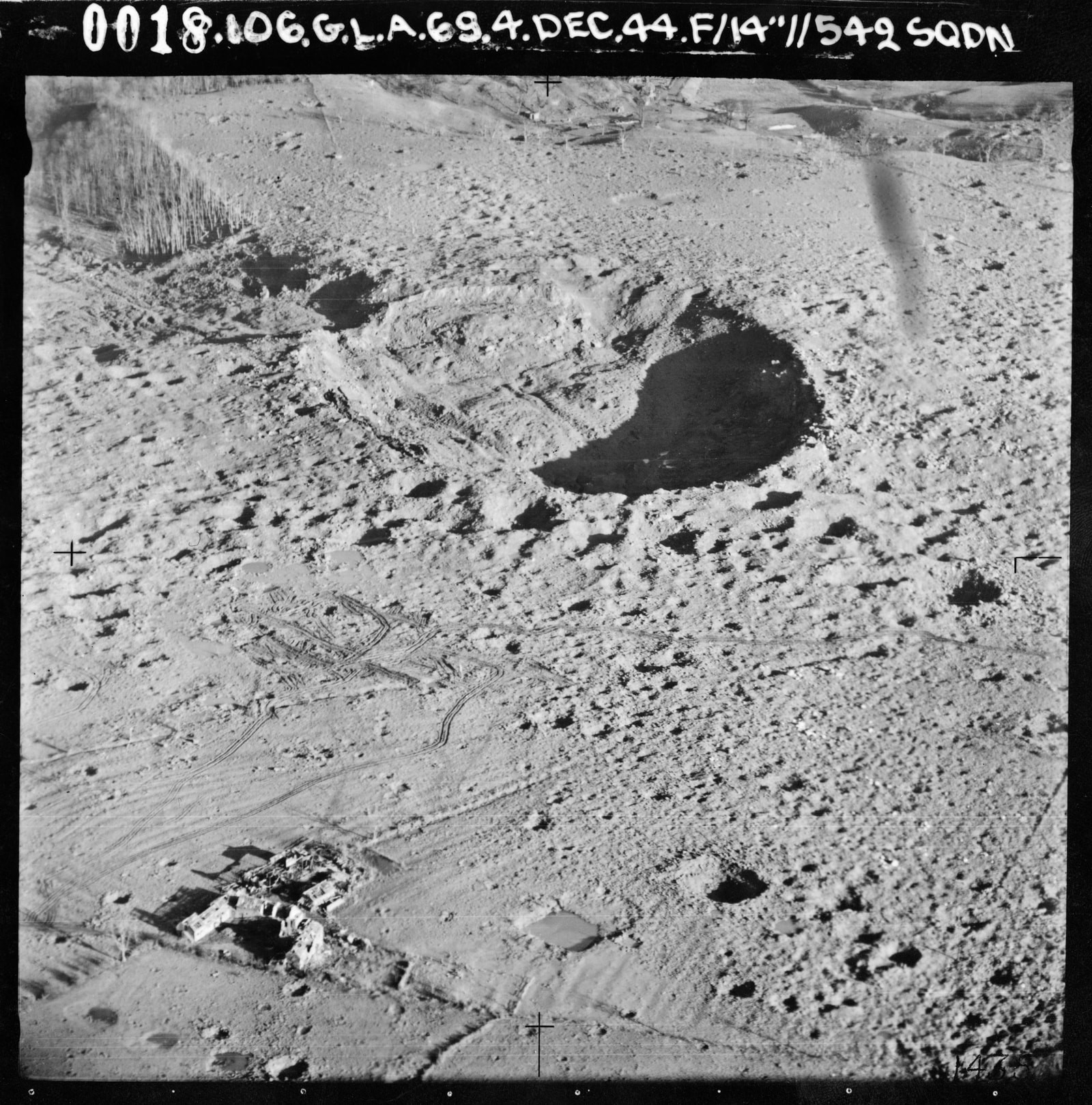
At 11:11 on 27 November 1944, between 3,500 and 4,000 tonnes of explosives detonated at once. The blast tore a crater about 30 metres deep and up to 307 metres across, covering some 12 acres. Upper Castle Hayes Farm vanished. A nearby reservoir holding 450,000 cubic metres of water was destroyed, and the flood swept into the gypsum works of Peter Ford and Sons.
The toll
No exact count of the dead was possible, because records of the workforce were incomplete and censorship limited what was published. The official report counted 26 killed or missing at the dump itself, 37 drowned or missing at the gypsum mine and in the surrounding countryside, about seven at Upper Castle Hayes Farm, and one diver killed during the search. At least 70 people are believed to have died.
A secret investigation, not made public until 1974, concluded that the likely cause was a worker removing a detonator from a live bomb with a brass chisel instead of a wooden tool. It also pointed to staff shortages, poor training, unclear command and the pressure of wartime production.
Sources and further reading
Lead image: Aerial view of the Fauld crater in Staffordshire, December 1944. Royal Air Force, Public domain, via Wikimedia Commons. See our sources and image policy.
 United Kingdom
 United States
 Soviet Union
 Germany
 Japan
 France
 Poland
 South Africa