Occupied Europe · The Holocaust · Soviet Union, Germany and Poland
The Liberation of Auschwitz
Soviet soldiers reach the largest of the Nazi killing centres. They find around 7,000 prisoners left behind, most of them sick or dying.
- Location
- Oświęcim, occupied Poland
- Liberated by
- Red Army, 1st Ukrainian Front
- Prisoners found
- Around 7,000
- Murdered at the camp
- At least 1.1 million people, around 1 million of them Jews
- War clock
- Day 1,976 of 2,194
Auschwitz was a complex of camps near the Polish town of Oświęcim, annexed by Germany. It included a concentration camp, the extermination camp at Birkenau and a large forced-labour camp at Monowitz. From 1942 trains brought Jews from across Europe to Birkenau, where most were murdered in gas chambers on arrival. Poles, Roma, Soviet prisoners of war and others were also killed there.
The last days
As the Red Army approached in January 1945, the SS tried to destroy evidence, blowing up the crematoria and burning records. Around 58,000 prisoners were forced out on death marches westward in freezing conditions, and many thousands died on the way. Those too weak to walk were left behind.
Liberation
On the afternoon of 27 January 1945, troops of the Soviet 60th Army reached the camps. They found around 7,000 prisoners still alive, including children. They also found warehouses holding hundreds of thousands of items of clothing and enormous quantities of human hair.
Also on 27 January
- 1944The Red Army lifts the siege of Leningrad, about 872 days after it began.
Sources and further reading
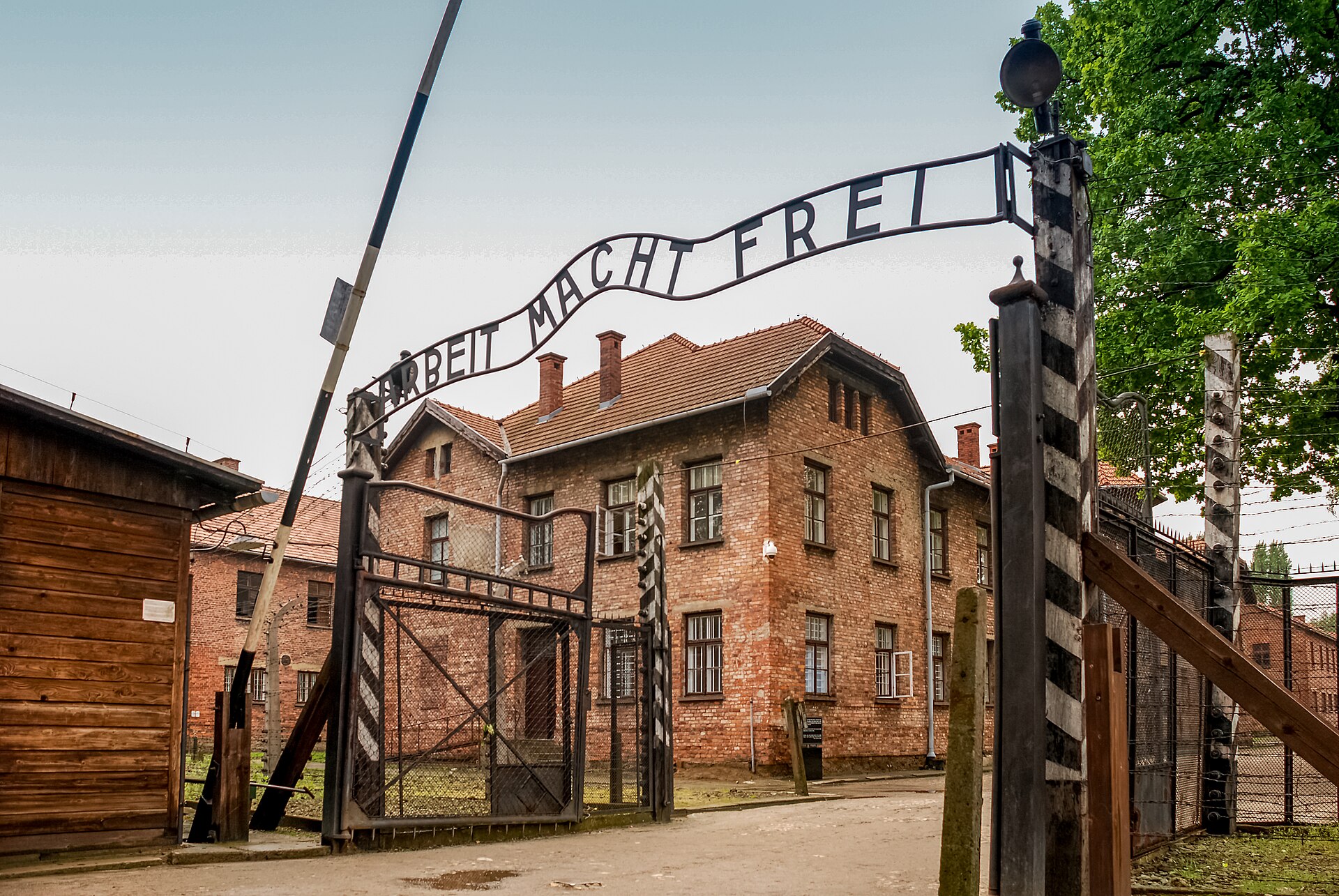
Lead image: The gate of Auschwitz I, now part of the Auschwitz-Birkenau State Museum. xiquinhos, CC BY 2.0 (licence), via Wikimedia Commons. See our sources and image policy.
 United Kingdom
 United States
 Soviet Union
 Germany
 Japan
 France
 Poland
 South Africa