Eastern Front · Land Battles · Soviet Union vs Germany
The Siege of Leningrad Ends
After 872 days, the Red Army drives the Germans from the southern outskirts of Leningrad and the siege of the city is declared over.
- Began
- 8 September 1941
- Lifted
- 27 January 1944
- Length
- 872 days
- Civilian deaths
- About 900,000 to 1 million
- Lifeline
- The Road of Life across Lake Ladoga
- War clock
- Day 1,610 of 2,194
German and Finnish forces cut Leningrad’s land links with the rest of the Soviet Union on 8 September 1941. Hitler meant to starve the city rather than storm it. In the winter of 1941 to 1942 hundreds of thousands of people died of hunger and cold.
The Road of Life
Supplies reached the city across Lake Ladoga, by boat in summer and by lorry over the ice in winter, on the route known as the Road of Life. It brought in food and fuel and carried out civilians and the wounded. In January 1943 Operation Iskra opened a narrow land corridor south of the lake, but the city remained within range of German guns.
Breaking the ring
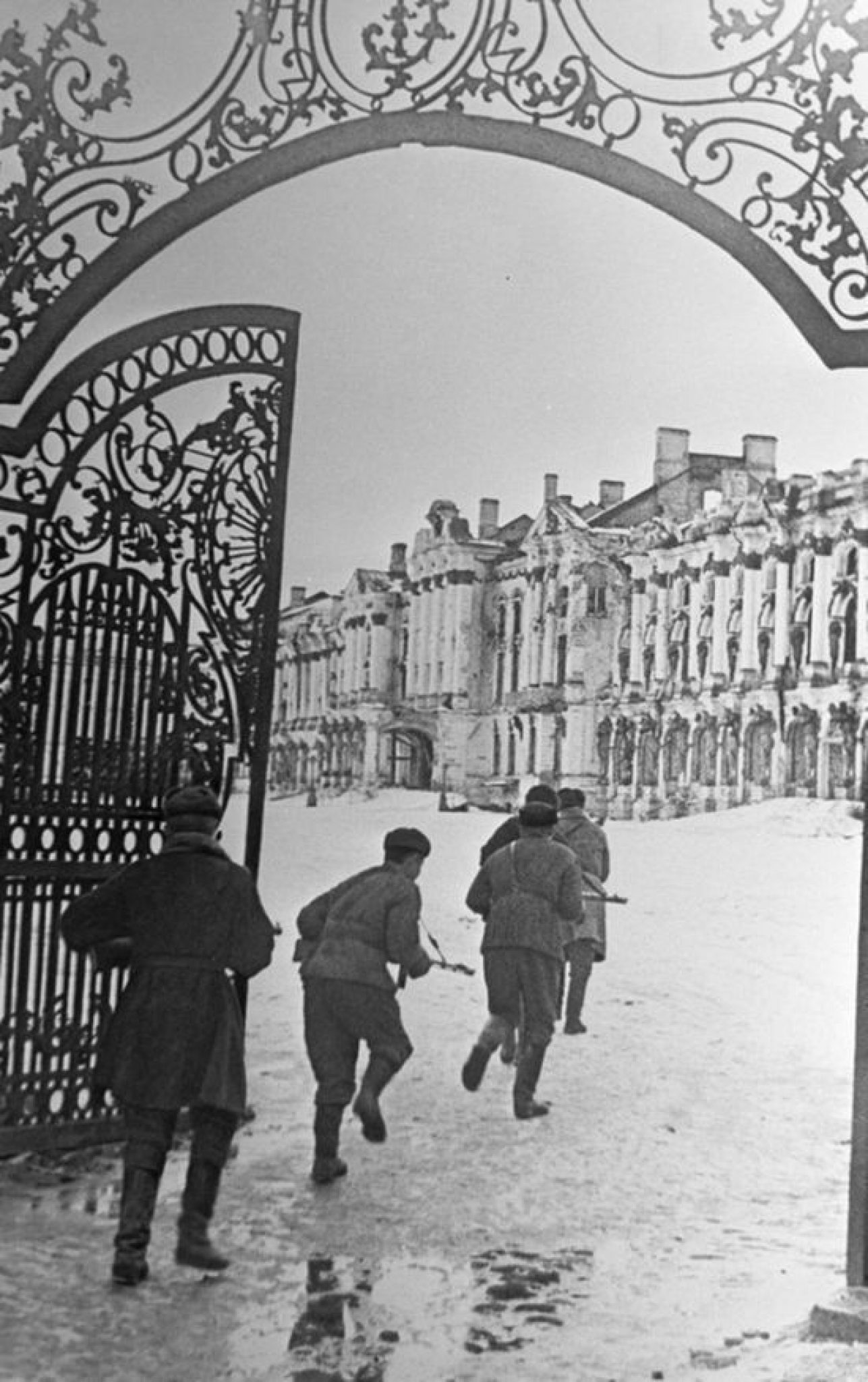
From 14 January 1944 the Leningrad and Volkhov Fronts launched a series of offensives. Within two weeks they had driven the Germans from the city’s southern outskirts and retaken towns such as Pushkin. On 27 January 1944 the siege was declared lifted, and Leningrad celebrated with an artillery salute.
Sources and further reading
Lead image: Soviet soldiers fighting in Pushkin during the breakthrough of the siege of Leningrad, January 1944. Boris Kudoyarov, CC BY-SA 3.0 (licence), via Wikimedia Commons. See our sources and image policy.
 United Kingdom
 United States
 Soviet Union
 Germany
 Japan
 France
 Poland
 South Africa