Western Europe · Land Battles · United Kingdom and United States vs Germany
Operation Varsity
Two airborne divisions land in a single lift beyond the Rhine, in the largest airborne operation ever carried out on one day in one place.
- Date
- 24 March 1945
- Divisions
- British 6th and US 17th Airborne
- Troops
- More than 16,000
- Aircraft
- About 1,590 transports and tugs, towing some 1,350 gliders
- Allied casualties
- About 2,400 to 2,700
- War clock
- Day 2,032 of 2,194
On the night of 23 March 1945 Montgomery’s 21st Army Group began Operation Plunder, the crossing of the Rhine near Wesel. The next morning, Operation Varsity dropped two airborne divisions on the far bank to seize the high ground, woods and bridges behind the German defences.
One lift
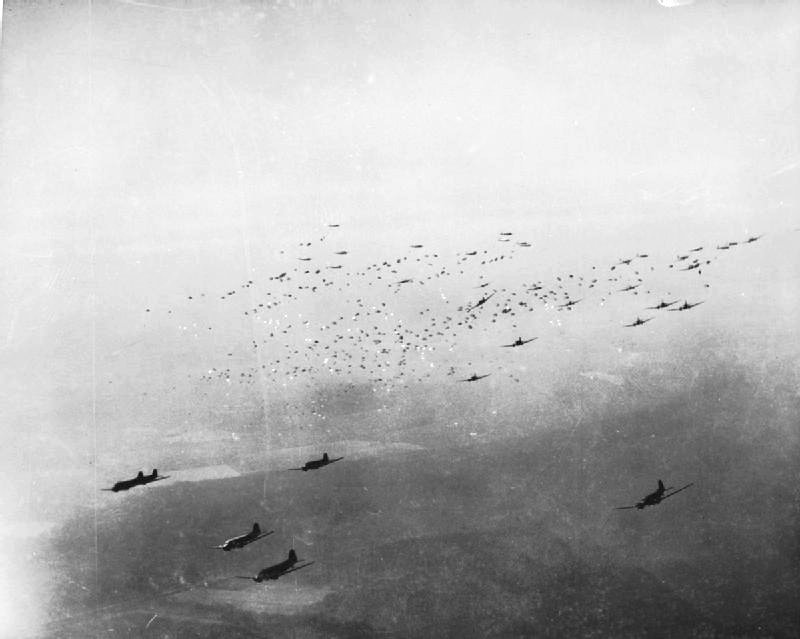
Varsity was launched after the river crossing had begun, in daylight and in a single lift. Some 541 transport aircraft and 1,050 tugs towing about 1,350 gliders carried more than 16,000 men of the British 6th and US 17th Airborne Divisions, under Major General Matthew Ridgway’s US XVIII Airborne Corps, with some 2,150 fighters overhead.
The landings were costly, and German anti-aircraft fire took a heavy toll of the gliders and transports, but by nightfall the divisions held their objectives and had linked up with the troops who had crossed the river. Corporal Frederick Topham of the 1st Canadian Parachute Battalion won the Victoria Cross for rescuing and treating wounded men under fire.
Sources and further reading
Lead image: C-47 transports release paratroopers over the Rhine during Operation Varsity, 24 March 1945. US Army Signal Corps, Public domain, via Wikimedia Commons. See our sources and image policy.
 United Kingdom
 United States
 Soviet Union
 Germany
 Japan
 France
 Poland
 South Africa