Pacific · Land Battles · United States vs Japan
The Flag on Suribachi
Marines reach the summit of Mount Suribachi and raise the Stars and Stripes. A second, larger flag raised hours later becomes the most famous photograph of the war.
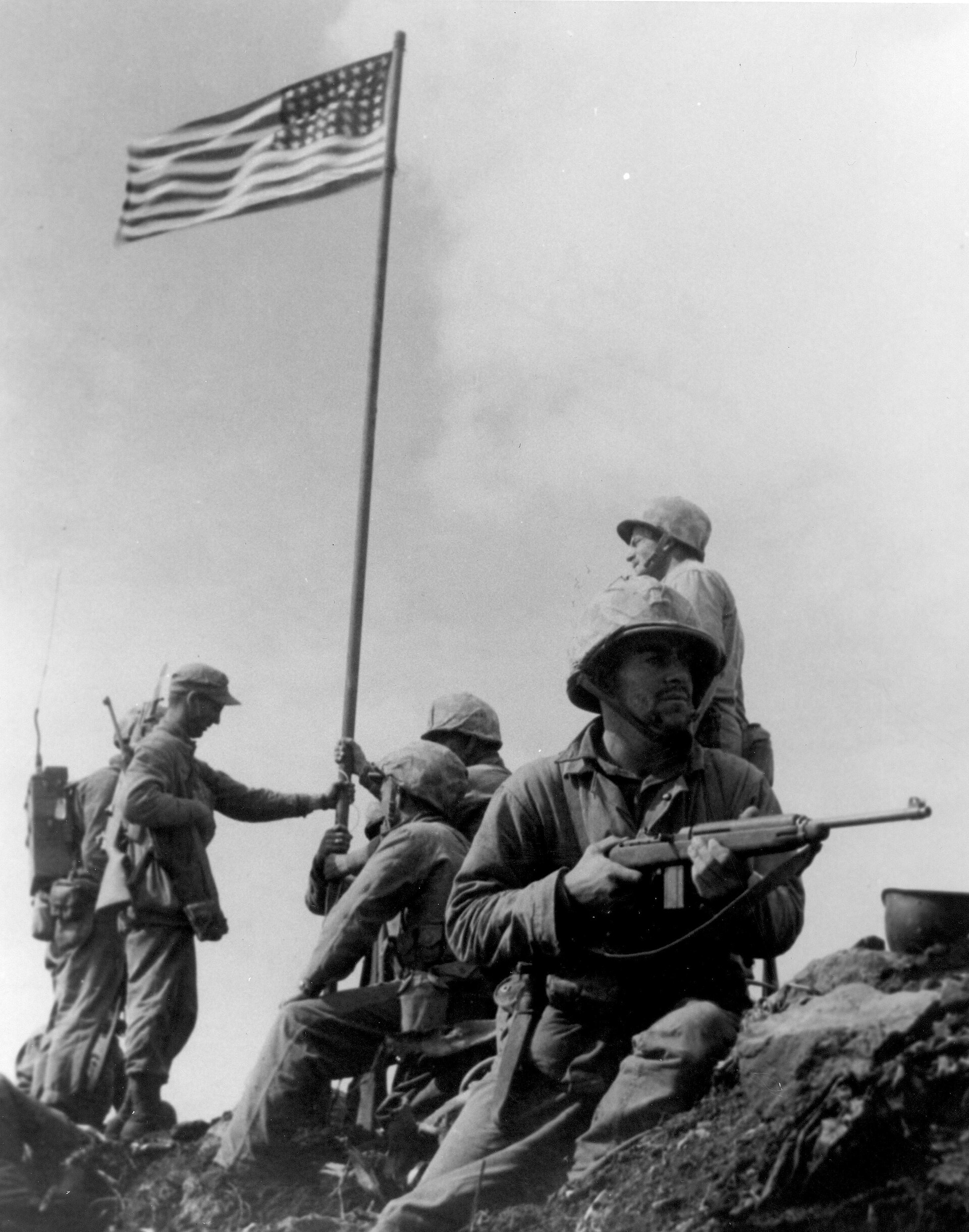
- Location
- Mount Suribachi, Iwo Jima
- Unit
- 2nd Battalion, 28th Marines
- First flag photographed by
- Staff Sgt Louis R. Lowery
- Battle ended
- 26 March 1945
- War clock
- Day 2,003 of 2,194
Iwo Jima, a small volcanic island halfway between the Marianas and Japan, was wanted for its airfields. The Japanese garrison under General Tadamichi Kuribayashi had turned it into a fortress of tunnels, bunkers and caves. When the Marines landed on 19 February 1945 they came under fire from Mount Suribachi, the extinct volcano at the island’s southern tip.
The first flag
After four days of fighting, the 28th Marines had cut off Suribachi. On the morning of 23 February a patrol climbed to the summit and raised a small American flag on a length of pipe. Ships offshore sounded their horns, and Marines across the island cheered. Lowery, a Marine photographer, recorded the moment.
The second flag
A larger flag was sent up later so it could be seen across the island. As six Marines raised it, Associated Press photographer Joe Rosenthal took the picture that became an icon. Three of the six men in his photograph were killed in the fighting that followed.
Sources and further reading
Lead image: The first US flag raised on Mount Suribachi, Iwo Jima. Staff Sergeant Louis R. Lowery, USMC, staff photographer for, Public domain, via Wikimedia Commons. See our sources and image policy.
 United Kingdom
 United States
 Soviet Union
 Germany
 Japan
 France
 Poland
 South Africa