Eastern Front · Deportations · Soviet Union
The Deportation of the Chechens and Ingush
On Red Army Day, NKVD troops begin rounding up the entire Chechen and Ingush peoples. Within days nearly half a million are on their way to Central Asia.
- Began
- 23 February 1944
- Code name
- Operation Lentil (Chechevitsa)
- Deported
- About 496,000
- Forces
- About 19,000 NKVD officers and 100,000 troops
- Exile
- 13 years, until 1957
- War clock
- Day 1,637 of 2,194
In 1943 and 1944 Stalin’s regime deported several whole peoples of the North Caucasus and Crimea, accusing them of collaborating with the Germans. Among the largest groups were the Chechens and Ingush. The charge was never proven in any court, and the Germans had never reached the Chechen-Ingush republic.
Operation Lentil
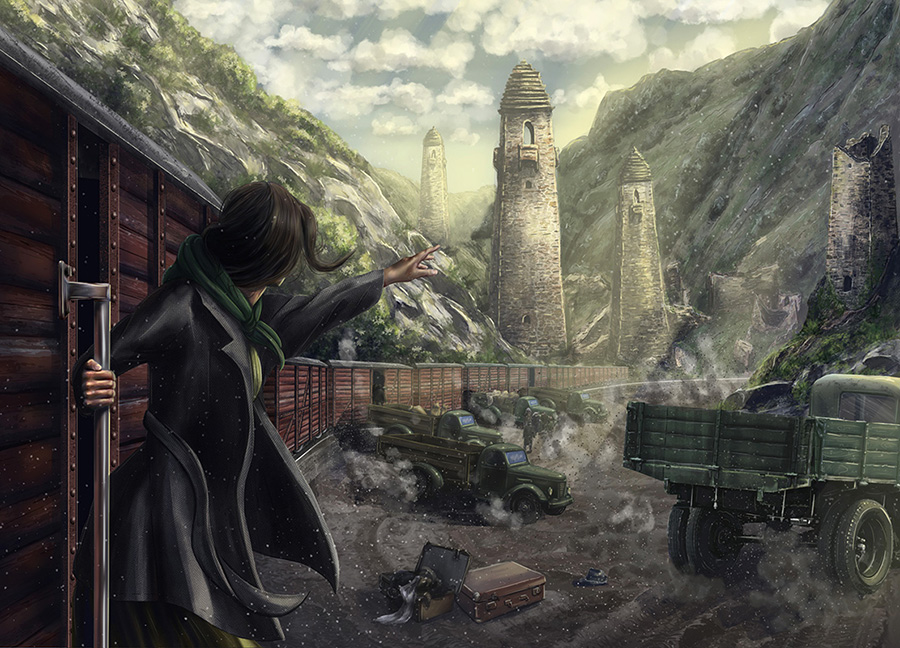
The operation, ordered by Lavrentiy Beria with Stalin’s approval, began on 23 February 1944, Red Army Day. Some 19,000 NKVD officers and 100,000 troops had been moved into the region beforehand. Villagers were assembled, loaded onto lorries and packed into trains bound for Kazakhstan and Kyrgyzstan. In July Beria reported to Stalin that 496,460 people had been deported.
Resistance and remote villages were dealt with brutally. At Khaibakh, in the mountains, about 700 people were reportedly locked in a barn and burned to death.
Exile
In the special settlements, hunger, cold and disease killed tens of thousands. Estimates of the deaths caused by the deportation range from more than 100,000 to 200,000, and Chechen sources give higher figures still.
Sources and further reading
Lead image: Chechevitsa (Lentil), a painting of the 1944 deportation of the Chechen and Ingush peoples by Vera Yanskaya. Vera Yanskaya, CC BY-SA 4.0 (licence), via Wikimedia Commons. See our sources and image policy.
 United Kingdom
 United States
 Soviet Union
 Germany
 Japan
 France
 Poland
 South Africa