Western Europe · Air War · Britain and the United States vs Germany
The Bombing of Dresden
RAF bombers attack the baroque city of Dresden in two waves by night, followed by American raids by day. The firestorm that follows becomes one of the most debated acts of the war.
- Location
- Dresden, Saxony, Germany
- Raids
- Night of 13/14 February, then 14 and 15 February 1945
- Attackers
- RAF Bomber Command and US Eighth Air Force
- Deaths
- About 25,000, according to a 2010 historians’ commission
- War clock
- Day 1,993 of 2,194
By early 1945 Dresden was one of the few large German cities not yet heavily bombed. It was a major rail junction and contained industry, and it lay behind the Eastern Front, now drawing close as the Red Army advanced. The Allies had planned heavy raids on cities in eastern Germany to disrupt German communications and the movement of troops and refugees.
The firestorm
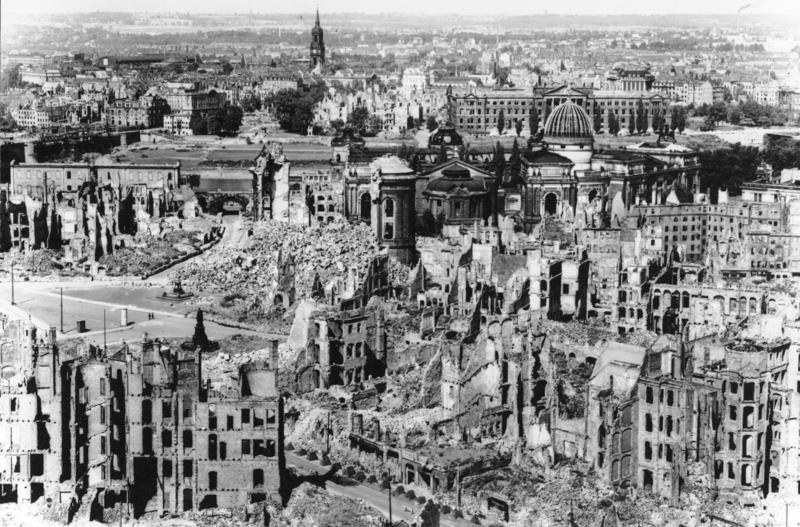
On the night of 13 February 1945 RAF Lancasters attacked in two waves, a few hours apart. The concentrated bombing of the old city centre with high explosives and incendiaries created a firestorm, which drew in air at great speed and burned at intense heat. The US Eighth Air Force followed with daylight raids on 14 and 15 February, aimed mainly at the railway yards.
Counting the dead
Nazi propaganda quickly claimed enormous figures, and inflated numbers circulated for decades. A commission of historians appointed by the city concluded in 2010 that up to around 25,000 people were killed. The historic centre, including the Frauenkirche, was destroyed.
Also on 13 February
- 1945The siege of Budapest ends as the last German and Hungarian defenders in the city surrender.
Sources and further reading
Lead image: The ruins of Dresden after the bombing of February 1945. Unknown photographer, Bundesarchiv, CC BY-SA 3.0 de (licence), via Wikimedia Commons. See our sources and image policy.
 United Kingdom
 United States
 Soviet Union
 Germany
 Japan
 France
 Poland
 South Africa