Eastern Front · Land Battles · Soviet Union vs Germany
The Vistula-Oder Offensive
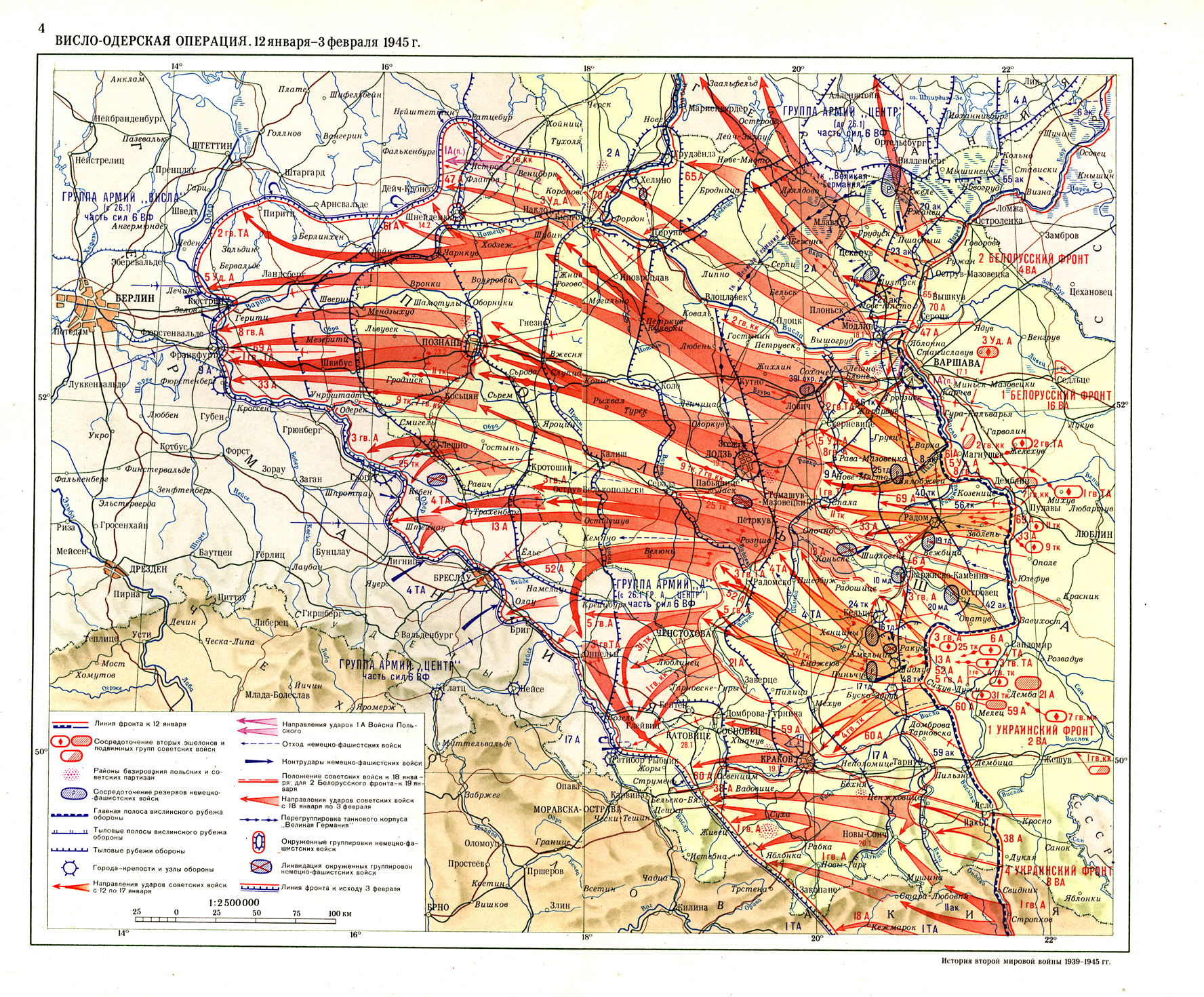
From its bridgeheads on the Vistula, the Red Army launches its greatest offensive of the war. In three weeks it will advance hundreds of kilometres to the Oder, within striking distance of Berlin.
- Location
- Poland and eastern Germany
- Belligerents
- Soviet Union and Poland vs Germany
- Soviet commanders
- Marshals Ivan Konev and Georgy Zhukov
- Result
- Red Army reaches the Oder, around 70 km from Berlin
- War clock
- Day 1,961 of 2,194
By the end of 1944 the Red Army held bridgeheads across the Vistula river in central Poland. Facing them, the German Army Group A was badly outnumbered in men, tanks, guns and aircraft. Germany’s generals warned that the front could not hold, but many of the available reserves had been sent to the west for the Ardennes offensive or to Hungary.
The breakthrough
On 12 January 1945, after a massive bombardment, Marshal Ivan Konev’s 1st Ukrainian Front attacked from the Sandomierz bridgehead. Two days later Marshal Georgy Zhukov’s 1st Belorussian Front followed from bridgeheads further north. The German defences broke within days. Warsaw was liberated on 17 January, and Kraków soon after.
To the Oder
Soviet tank armies drove west across Poland at a speed not seen since 1941. By the end of January Zhukov’s troops had reached the Oder and seized bridgeheads on its western bank. Millions of German civilians fled west in winter conditions.
Sources and further reading
Lead image: Soviet forces during the Vistula-Oder offensive, January 1945. Ministry of Defence of USSR, Public domain, via Wikimedia Commons. See our sources and image policy.
 United Kingdom
 United States
 Soviet Union
 Germany
 Japan
 France
 Poland
 South Africa