Pacific · War at Sea · United States vs Japan
Halsey Strikes the South China Sea
Carrier aircraft of the US Third Fleet fall on Japanese shipping along the coast of French Indochina, in one of the most destructive days of the war at sea.
- Operation
- Gratitude
- Commander
- Admiral William Halsey
- Force
- Task Force 38
- Targets
- Cam Ranh Bay, Qui Nhon and Saigon
- Ships sunk on 12 January
- About 44 to 46
- War clock
- Day 1,961 of 2,194
In January 1945, as American troops landed at Lingayen Gulf on Luzon, Admiral William Halsey took the Third Fleet into the South China Sea to strike Japanese shipping and bases. The fleet entered on the night of 9 to 10 January.
12 January
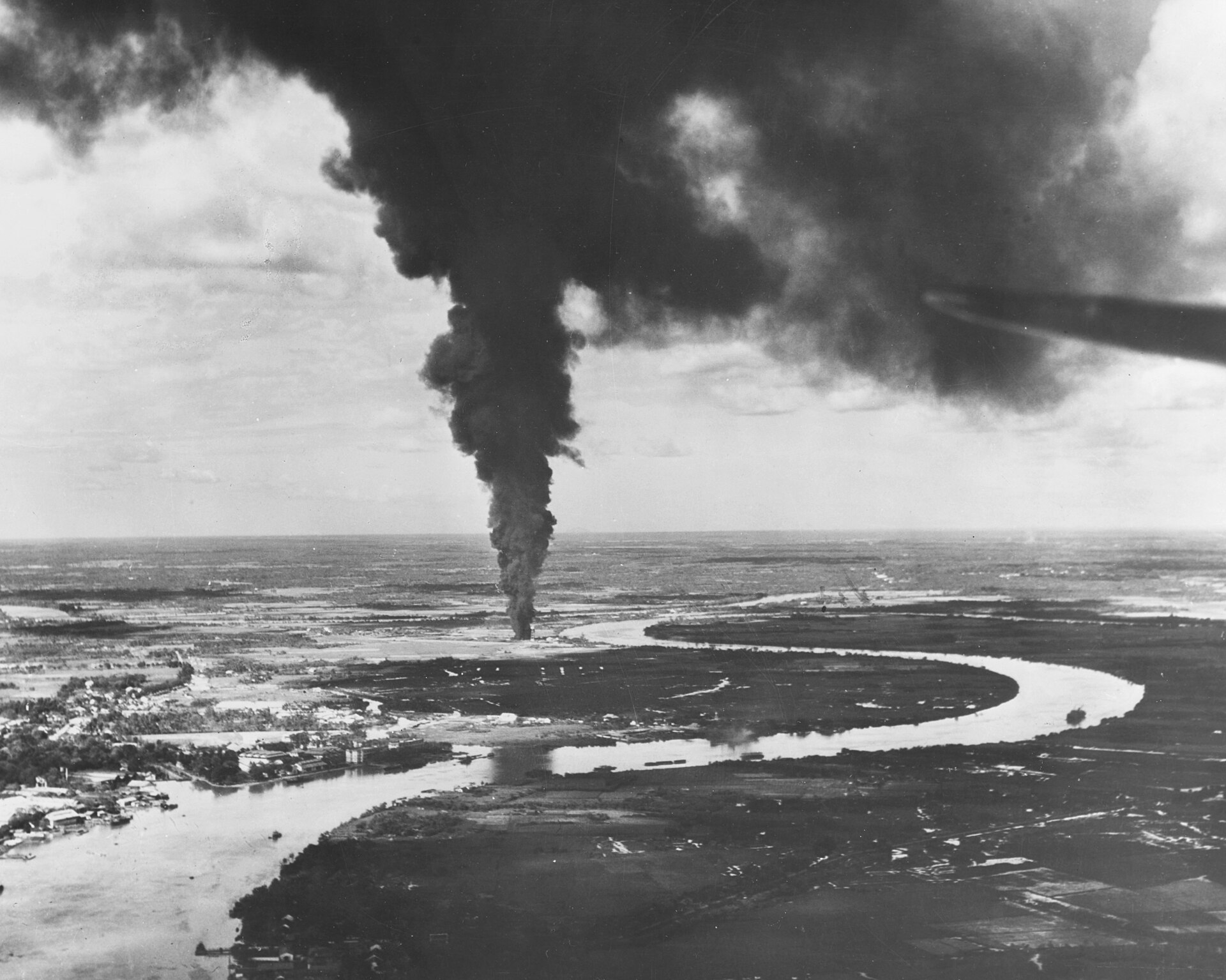
On 12 January the carrier aircraft of Task Force 38 attacked along the coast of French Indochina, at Cam Ranh Bay, Qui Nhon and Saigon, catching convoys at sea and ships in harbour. Accounts differ slightly, but some 44 to 46 Japanese ships were sunk that day, among them 33 merchant vessels of more than 142,000 tons, including 12 tankers.
Japanese air opposition was weak. The Americans shot down 15 aircraft, destroyed 20 floatplanes at Cam Ranh Bay and caught 77 more at airfields, for the loss of 23 of their own.
The rest of the sweep
The fleet went on to strike Hong Kong and the coast of China before leaving the South China Sea on 20 January.
Sources and further reading
Lead image: Ships and installations ablaze on the Saigon waterfront after US Navy carrier strikes, 12 January 1945. US Navy, Public domain, via Wikimedia Commons. See our sources and image policy.
 United Kingdom
 United States
 Soviet Union
 Germany
 Japan
 France
 Poland
 South Africa