Pacific · Land Battles · United States vs Japan
The Landings on Kwajalein
American soldiers and marines storm the heart of the Marshall Islands. The lessons of Tarawa have been learned, and the cost is far lower.
- Location
- Kwajalein Atoll, Marshall Islands
- Operation
- Flintlock
- US forces
- 4th Marine Division and 7th Infantry Division
- Result
- Atoll secured by 4 February
- War clock
- Day 1,615 of 2,194
The Marshall Islands had been Japanese territory since the end of the First World War, and their atolls held airfields and anchorages guarding the approaches to Japan’s inner defences. After taking the Gilbert Islands in November 1943, the US Central Pacific force turned to the Marshalls. Admiral Chester Nimitz chose to strike directly at Kwajalein, at the centre of the group, bypassing the outer islands.
After Tarawa
The landing at Tarawa had cost the US Marines heavily, and the planners took its lessons to heart. Kwajalein was pounded for days by carrier aircraft, land-based bombers and warships firing at close range. More amphibious tractors were provided to carry troops over the reefs, and artillery was landed on neighbouring islets before the main assault.
The assault
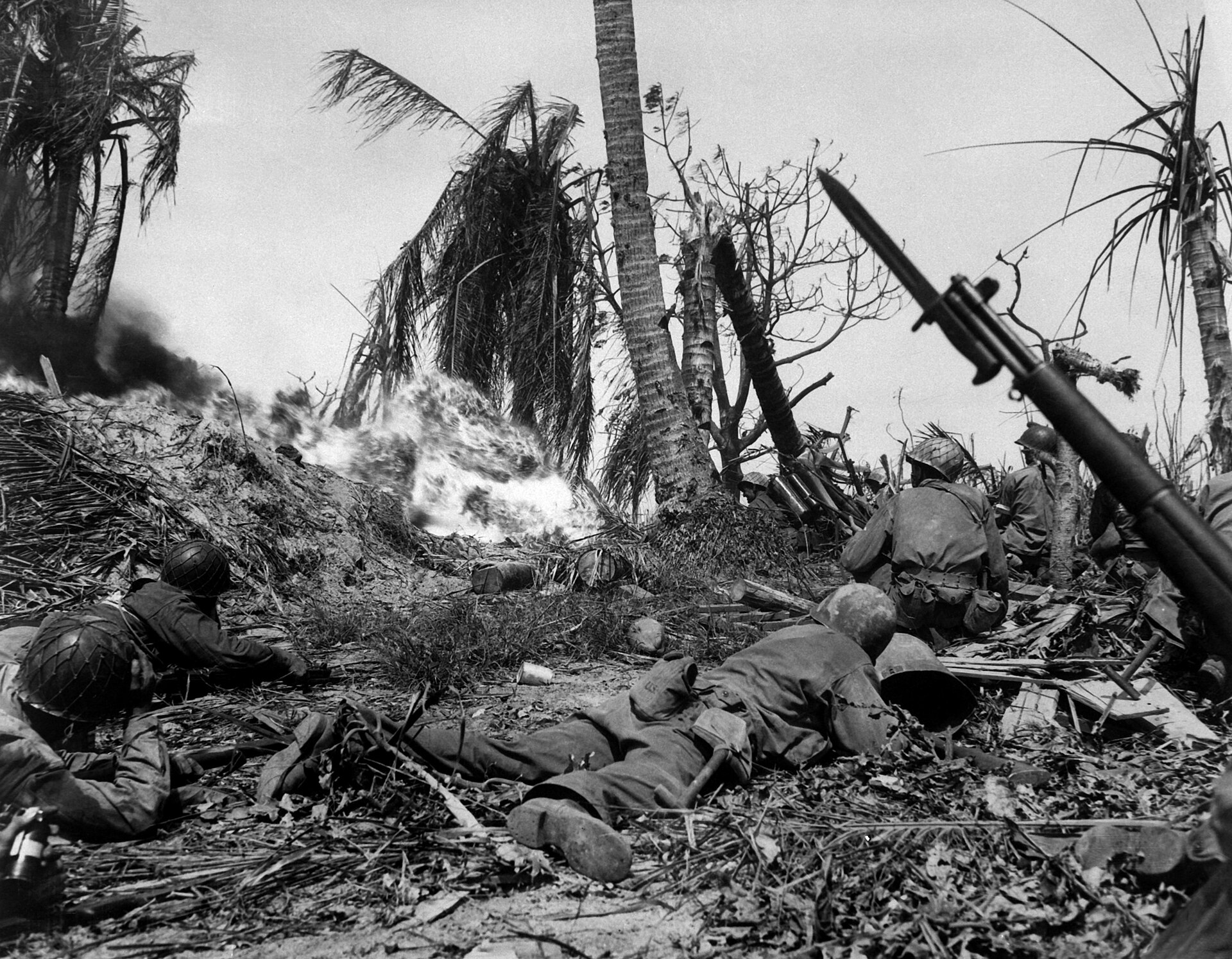
On 1 February 1944 the 4th Marine Division landed on the linked islands of Roi and Namur in the north of the atoll, while the US Army’s 7th Infantry Division landed on Kwajalein Island in the south. Roi-Namur was secured the next day. On Kwajalein Island the Japanese garrison fought on from bunkers and ruins until 4 February. Almost all the defenders were killed; American losses were a fraction of those at Tarawa.
Also on 1 February
- 1942Vidkun Quisling is installed as Minister President of occupied Norway; his name becomes a byword for traitor.
Sources and further reading
- Wikipedia: Battle of Kwajalein
- Wikipedia: Gilbert and Marshall Islands campaign
- Wikipedia: Vidkun Quisling
Lead image: US Army 7th Infantry Division soldiers on Kwajalein. CORDRAY, Public domain, via Wikimedia Commons. See our sources and image policy.
 United Kingdom
 United States
 Soviet Union
 Germany
 Japan
 France
 Poland
 South Africa