Italy · Land Battles · The Allies vs Italy and Germany
The Invasion of Sicily
On a stormy night, Allied paratroopers and gliders take off for Sicily. By dawn, the largest amphibious landing yet attempted is under way.
- Operation
- Husky
- Armies
- US Seventh Army (Patton) and British Eighth Army (Montgomery)
- Includes
- 1st Canadian Infantry Division
- Sicily taken
- 17 August 1943
- War clock
- Day 1,408 of 2,194
At Casablanca the Allies had agreed that, once North Africa was won, they would invade Sicily. It would open the Mediterranean to Allied shipping and, they hoped, knock Italy out of the war. A deception plan, including a corpse carrying false documents washed ashore in Spain, persuaded Hitler that the target might be Greece or Sardinia.
Into the wind
On the evening of 9 July 1943 American paratroopers and British glider troops set off for Sicily. Strong winds scattered the paratroopers over a wide area, and many British gliders were released too early and came down in the sea. Small groups of airborne troops nevertheless seized bridges and disrupted the defences.
The landings
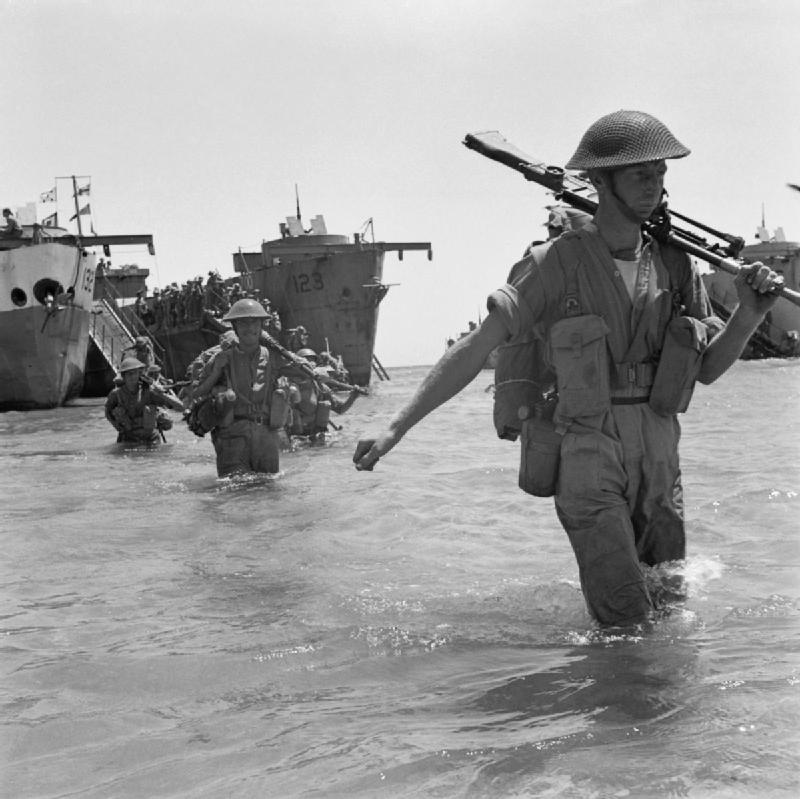
Early on 10 July, American, British and Canadian troops landed on beaches along the south-east of the island. Many Italian coastal units offered little resistance, but German and Italian mobile forces counterattacked. Over five weeks the Allies cleared the island, though much of the German force escaped across the Strait of Messina.
Sources and further reading
Lead image: British troops wade ashore in Sicily, July 1943. War Office official photographer, Public domain, via Wikimedia Commons. See our sources and image policy.
 United Kingdom
 United States
 Soviet Union
 Germany
 Japan
 France
 Poland
 South Africa