Eastern Front · Land Battles · Germany vs Soviet Union
The Battle of Kursk
Germany launches its last great offensive in the east against the Kursk salient. The Red Army, warned in advance, is waiting behind the deepest defences of the war.
- German operation
- Zitadelle (Citadel)
- German commanders
- Field Marshals Erich von Manstein and Walter Model
- Soviet commanders
- Konstantin Rokossovsky, Nikolai Vatutin, Ivan Konev
- Offensive halted
- Called off by Hitler on 13 July
- War clock
- Day 1,404 of 2,194
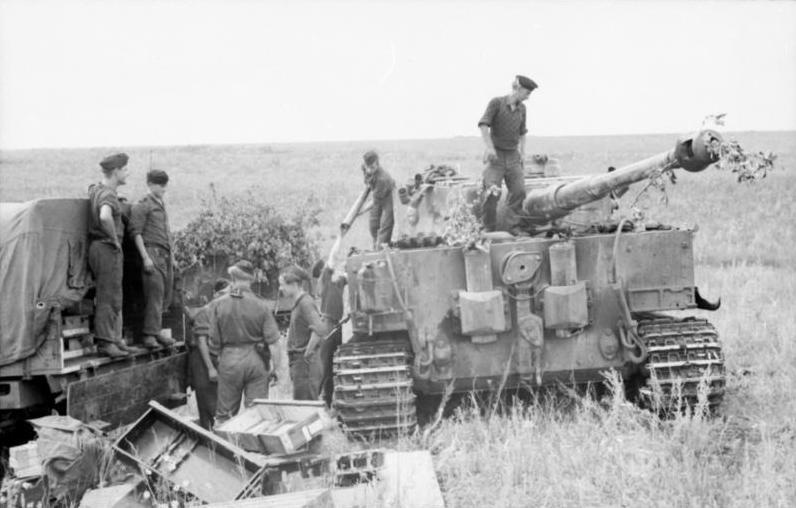
After Stalingrad, the front in southern Russia settled into a large bulge around the city of Kursk. Hitler planned to cut it off with attacks from north and south, destroying the Soviet forces inside. He delayed the attack several times to bring up new Tiger and Panther tanks.
The defences
Soviet intelligence learned of the plan. The Red Army used the months of delay to build belts of trenches, minefields and anti-tank positions many kilometres deep, and placed large reserves behind them. When the Germans attacked on 5 July 1943, Soviet artillery had already opened fire on their assembly areas.
Grinding to a halt
In the north, Model’s 9th Army made little progress. In the south, Manstein’s armour broke through several lines but suffered heavy losses. On 12 July a great tank battle was fought near Prokhorovka, and the Red Army launched its own offensive north of Kursk. With the Allies landing in Sicily, Hitler called off the offensive.
Sources and further reading
Lead image: A Tiger tank crew loading ammunition on the Eastern Front, 1943. Wolff, Paul Dr, CC BY-SA 3.0 de (licence), via Wikimedia Commons. See our sources and image policy.
 United Kingdom
 United States
 Soviet Union
 Germany
 Japan
 France
 Poland
 South Africa