Pacific · War at Sea · United States vs Japan
The Battle of Midway
In five minutes, American dive bombers set three Japanese aircraft carriers ablaze. By nightfall a fourth is burning. The tide of the Pacific war has turned.
- Location
- Near Midway Atoll, central Pacific
- Dates
- 4 to 7 June 1942
- US commanders
- Adms Chester Nimitz, Frank Jack Fletcher and Raymond Spruance
- Japanese carriers sunk
- Akagi, Kaga, Sōryū, Hiryū
- War clock
- Day 1,008 of 2,194
Admiral Yamamoto planned to seize Midway Atoll and draw the remaining American carriers into a decisive battle. But American codebreakers at Pearl Harbor had broken enough of the Japanese naval code to learn the target and the timing. Admiral Chester Nimitz sent his three available carriers, including the hastily repaired Yorktown, to wait north-east of Midway.
The morning of 4 June
Japanese aircraft attacked Midway at dawn. American aircraft from Midway and then from the carriers attacked the Japanese fleet. Wave after wave of torpedo bombers was shot down without scoring a hit. Then, at around 10:20, dive bombers from Enterprise and Yorktown arrived overhead while the Japanese carriers’ decks were crowded with armed and fuelled aircraft. Within minutes Akagi, Kaga and Sōryū were wrecked.
The cost
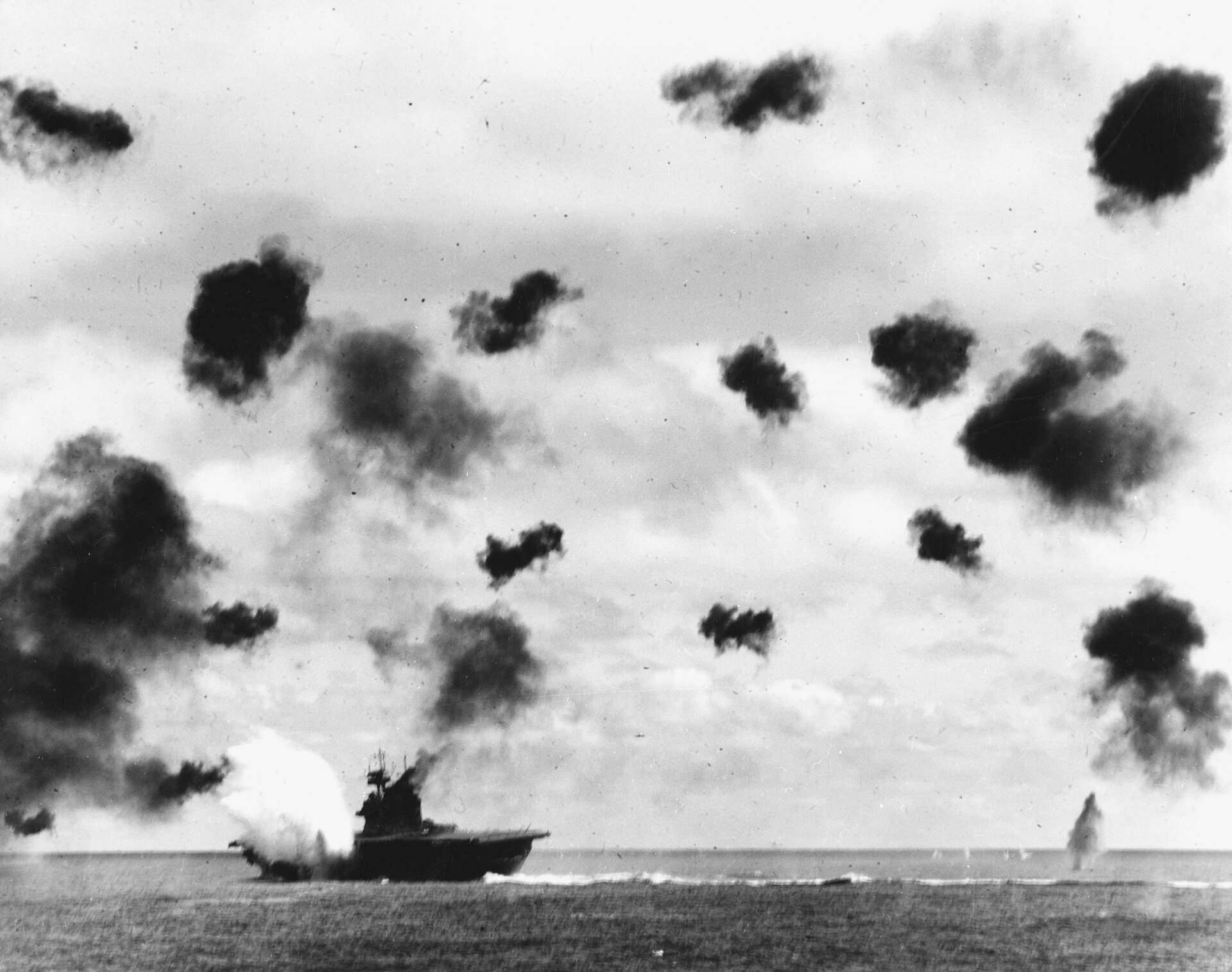
The fourth carrier, Hiryū, launched strikes that crippled Yorktown, but American aircraft found and sank her that afternoon. Yorktown was later sunk by a Japanese submarine. Japan lost four fleet carriers and many skilled aircrew.
Also on 4 June
- 1940As the Dunkirk evacuation ends, Churchill tells Parliament that Britain will fight on the beaches and never surrender.
- 1944Allied troops enter Rome.
Sources and further reading
Lead image: USS Yorktown hit by a torpedo at Midway. US Navy, Public domain, via Wikimedia Commons. See our sources and image policy.
 United Kingdom
 United States
 Soviet Union
 Germany
 Japan
 France
 Poland
 South Africa