Western Front · Liberation · Netherlands, Canada and Germany
The Netherlands Liberated
At a hotel in Wageningen, the German commander in the Netherlands meets the Canadian general facing him to arrange the surrender. After five years of occupation and a winter of famine, the Dutch are free.
- Location
- Hotel de Wereld, Wageningen
- German commander
- Gen Johannes Blaskowitz
- Allied commander
- Lt Gen Charles Foulkes, I Canadian Corps
- Hunger Winter deaths
- Around 20,000
- War clock
- Day 2,074 of 2,194
The south of the Netherlands had been liberated in late 1944, but after the failure at Arnhem the north and west remained occupied. In the winter of 1944 to 1945 a German blockade of food and fuel, combined with a railway strike and a harsh winter, caused the Hunger Winter. Around 20,000 people died.
Food from the sky
In late April 1945 the Allies and the German authorities agreed a truce so that food could be dropped. In Operations Manna and Chowhound, British and American bombers dropped thousands of tonnes of food over the western Netherlands. Canadian troops, meanwhile, had liberated much of the east and north.
Wageningen
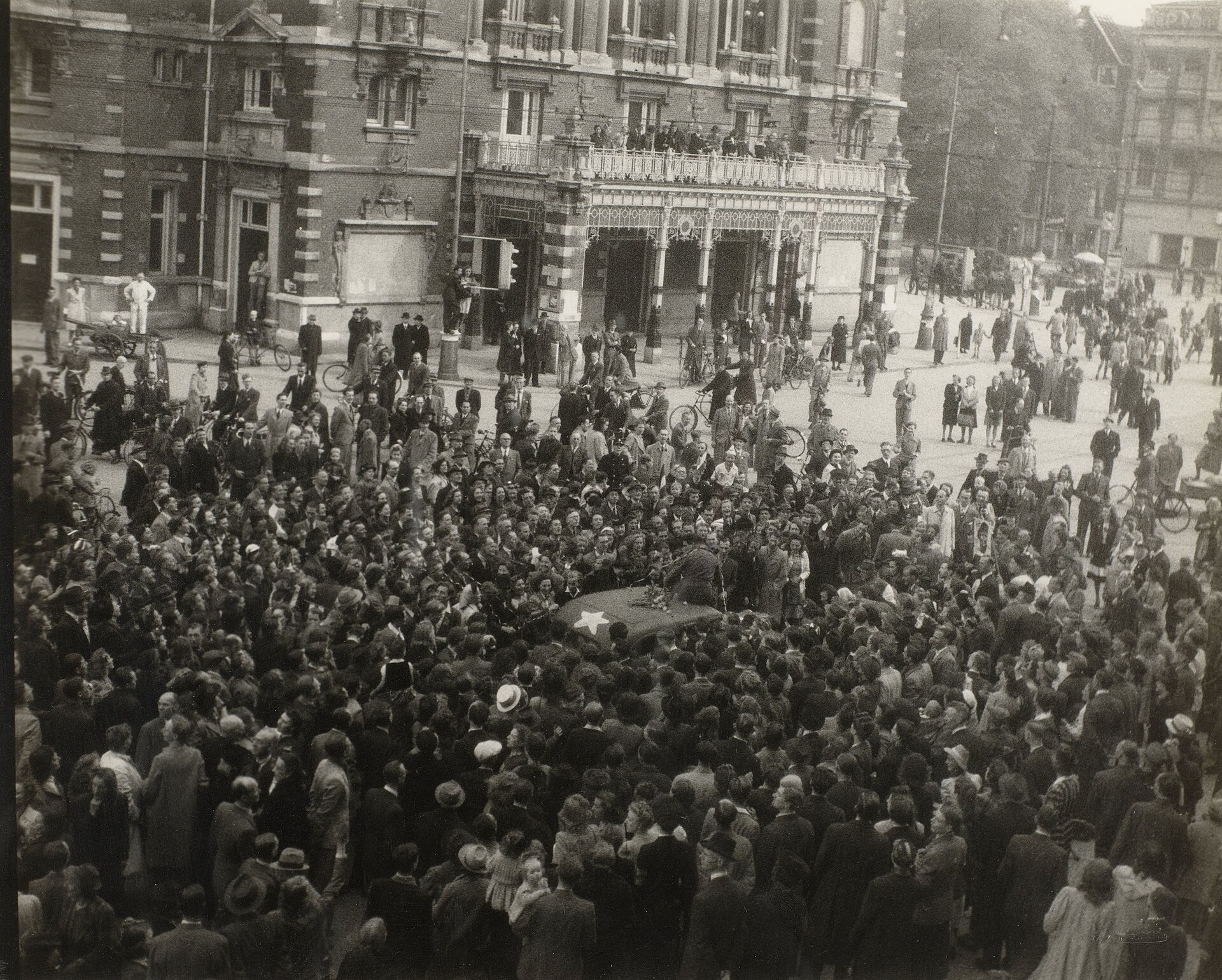
German forces in the Netherlands were included in the surrender signed at Lüneburg Heath on 4 May, which took effect the next morning. On 5 May General Johannes Blaskowitz met Lieutenant General Charles Foulkes at the Hotel de Wereld in Wageningen to settle the details; the formal document was signed the next day. Crowds filled the streets of Dutch towns to welcome the Canadians.
Also on 5 May
- 1945The Prague uprising begins against the German occupation of Czechoslovakia.
- 1945American troops liberate the Mauthausen concentration camp in Austria.
Sources and further reading
Lead image: Canadian soldiers among crowds in Amsterdam, May 1945. Rijksmuseum, CC0 (licence), via Wikimedia Commons. See our sources and image policy.
 United Kingdom
 United States
 Soviet Union
 Germany
 Japan
 France
 Poland
 South Africa