Eastern Front · Leaders · Germany
The Death of Hitler
With Soviet troops only a few hundred metres away, Adolf Hitler takes his own life in the bunker beneath the Reich Chancellery.
- Location
- Führerbunker, Berlin
- Time
- Mid-afternoon, 30 April 1945
- Successor named
- Grand Admiral Karl Dönitz, as president
- Announced
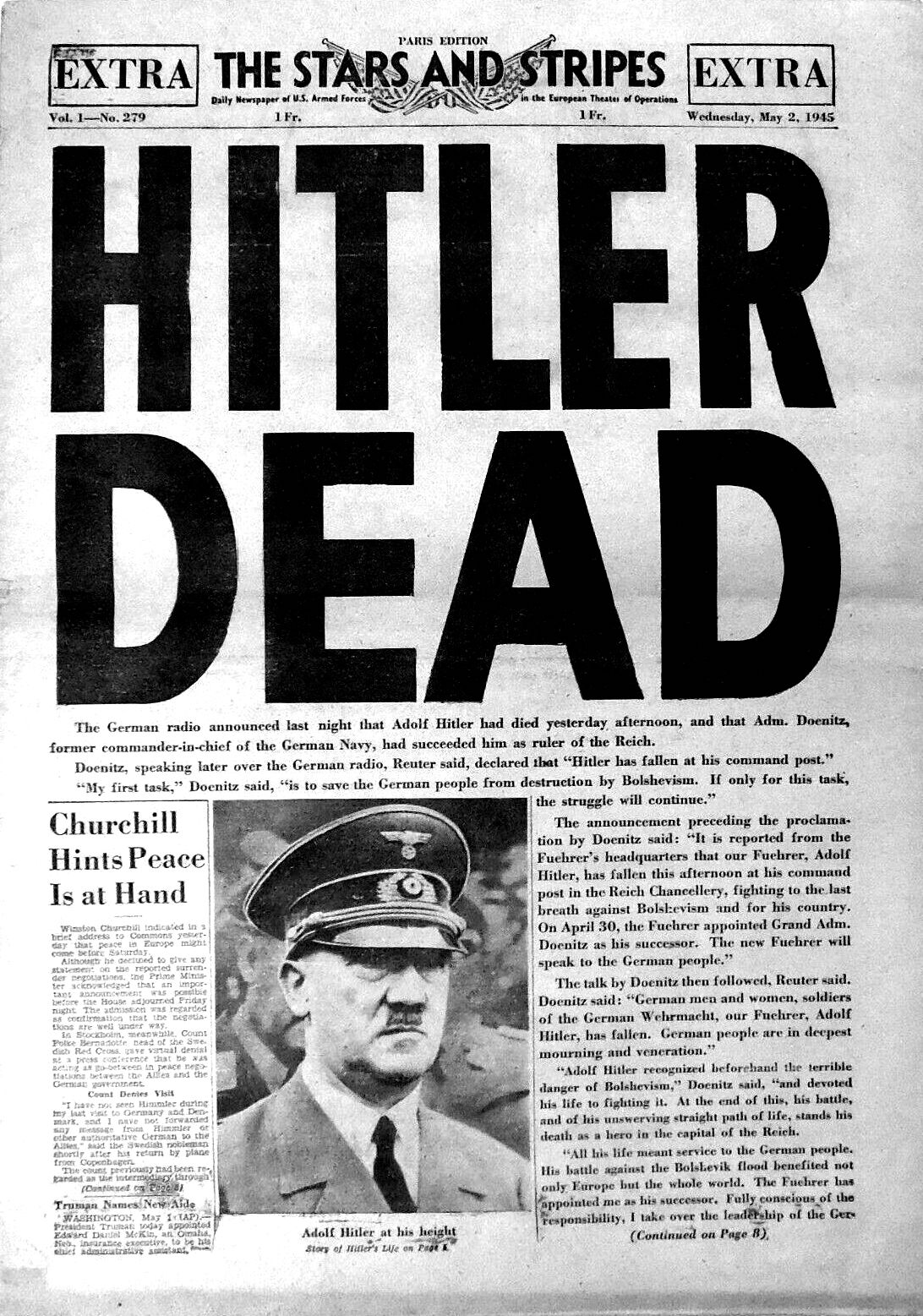
- On German radio, 1 May 1945
- War clock
- Day 2,069 of 2,194
By the end of April 1945 the Red Army had fought its way into the centre of Berlin. Hitler had decided to stay in the city. In the early hours of 29 April he married his long-time companion, Eva Braun, and dictated his last political testament, naming Grand Admiral Karl Dönitz as his successor as head of state and blaming the Jews for the war to the end.
The last day
On 30 April, after hearing that Mussolini had been executed and that the defenders of Berlin would soon run out of ammunition, Hitler said farewell to his staff. In the afternoon he shot himself in his private rooms; Braun took poison. Their bodies were carried up to the Chancellery garden and burned.
The Reichstag
That night Soviet soldiers were fighting inside the Reichstag. Joseph Goebbels and his wife killed their six children and then themselves the next day. On 1 May German radio announced that Hitler had fallen fighting at his post, a final lie.
Sources and further reading
Lead image: Stars and Stripes reports Hitler’s death. US Army, Public domain, via Wikimedia Commons. See our sources and image policy.
 United Kingdom
 United States
 Soviet Union
 Germany
 Japan
 France
 Poland
 South Africa