Balkans · Land Battles · Germany vs Yugoslavia
Yugoslavia Surrenders
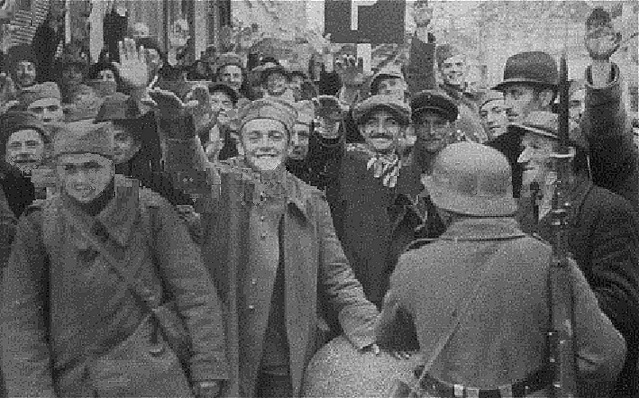
Eleven days after the invasion began, Yugoslav representatives sign an unconditional surrender in Belgrade. The country is carved up among its neighbours.
- Signed
- 17 April 1941, Belgrade
- Effective
- 18 April 1941
- Government
- King Peter II went into exile
- Prisoners
- Hundreds of thousands of Yugoslav soldiers
- War clock
- Day 595 of 2,194
The Yugoslav army was large but poorly equipped, spread along the whole frontier, and divided by tensions between its peoples. Under attack from several directions at once after 6 April 1941, it collapsed. Zagreb fell on 10 April, the day a Croatian fascist state was proclaimed, and Belgrade on 12 April.
The surrender
King Peter II and the government flew out of the country, eventually to London. On 17 April representatives of the Yugoslav army signed an armistice in Belgrade, amounting to unconditional surrender, which took effect the next day.
Partition
Yugoslavia was dismembered. Germany, Italy, Hungary and Bulgaria annexed or occupied parts of it. The so-called Independent State of Croatia, ruled by the Ustaše, began a campaign of mass murder against Serbs, Jews and Roma.
Sources and further reading
Lead image: Yugoslav soldiers surrendering at Skopje, April 1941. Unknown photographer, Public domain, via Wikimedia Commons. See our sources and image policy.
 United Kingdom
 United States
 Soviet Union
 Germany
 Japan
 France
 Poland
 South Africa