Western Front · The Holocaust · United States and Germany
The Liberation of Buchenwald
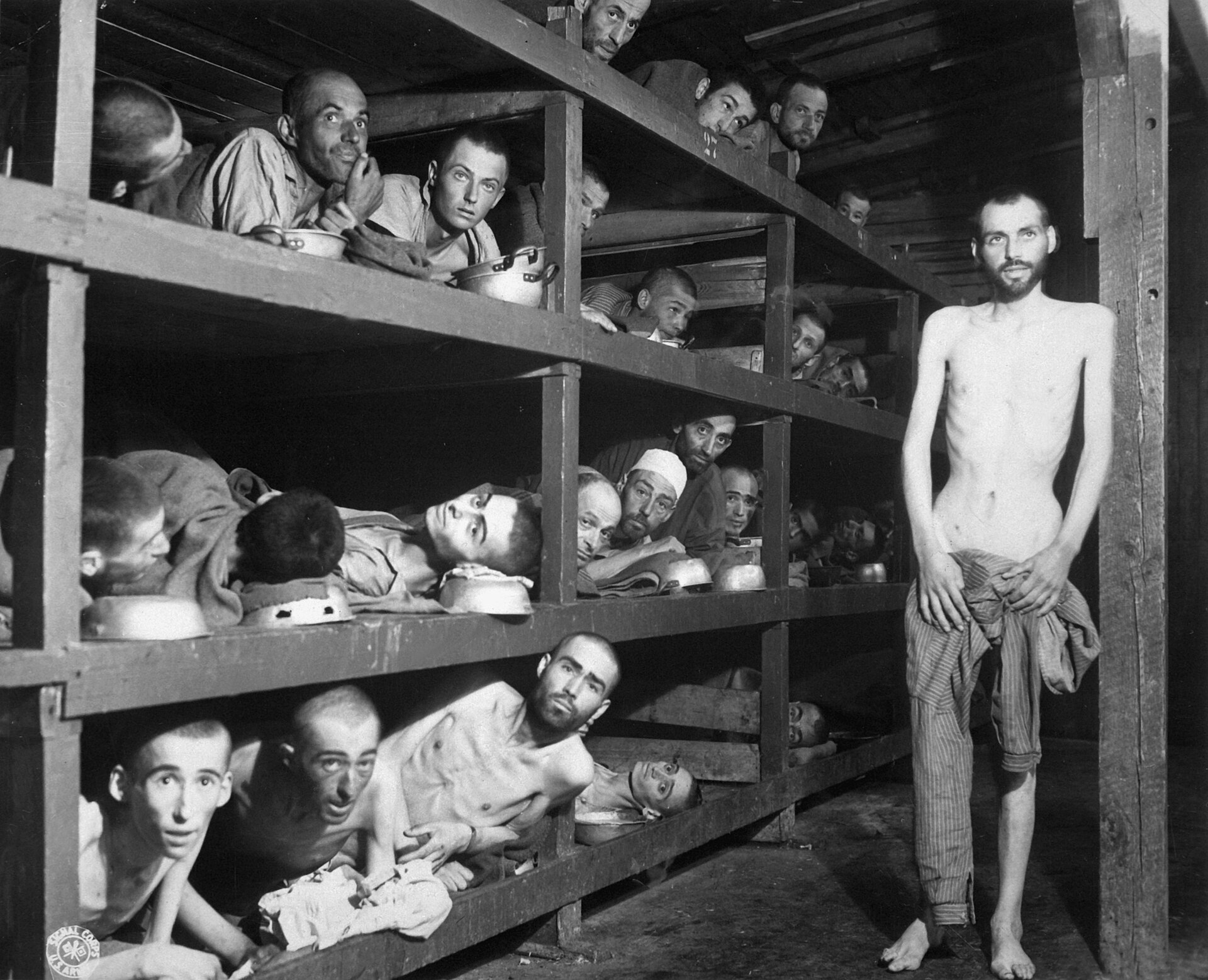
As the SS guards flee, prisoners take control of Buchenwald. That afternoon, American tanks arrive. More than 20,000 people are still alive inside.
- Location
- Near Weimar, Thuringia, Germany
- Liberated by
- US 6th Armored Division
- Survivors
- Around 21,000, including around 900 children
- Deaths at the camp
- Around 56,000 between 1937 and 1945
- War clock
- Day 2,050 of 2,194
Buchenwald, on a hill above the city of Weimar, was one of the largest concentration camps in Germany. Opened in 1937, it held political prisoners, Jews, Roma, Soviet prisoners of war and others. Tens of thousands died there from hunger, disease, overwork, medical experiments and executions.
The last days
In early April 1945 the SS began evacuating prisoners on death marches. A clandestine prisoners’ committee slowed the evacuation and hid many, including hundreds of children. On 11 April, as American forces approached, the guards fled and armed prisoners took over the camp.
Liberation
That afternoon troops of the US 6th Armored Division arrived. They found around 21,000 prisoners, many close to death. Among the children was the teenager Elie Wiesel, who later won the Nobel Peace Prize. Days later, on American orders, residents of Weimar were made to walk through the camp.
Sources and further reading
Lead image: Survivors in a barracks at Buchenwald after liberation. Private H. Miller. (Army), Public domain, via Wikimedia Commons. See our sources and image policy.
 United Kingdom
 United States
 Soviet Union
 Germany
 Japan
 France
 Poland
 South Africa