China-Burma-India · Land Battles · India and Britain vs Japan
Mandalay Retaken
After a siege of more than a week, the Japanese abandon Fort Dufferin. The Fourteenth Army holds Mandalay, the old royal capital of Burma.
- Location
- Mandalay, central Burma
- Army commander
- Lt Gen William Slim, Fourteenth Army
- Assault division
- 19th Indian Division
- Masterstroke
- Capture of Meiktila, 4 March 1945
- War clock
- Day 2,028 of 2,194
After their defeats at Imphal and Kohima in 1944, the Japanese armies in Burma fell back behind the Irrawaddy river. General William Slim’s Fourteenth Army, largely made up of Indian and African troops alongside British units, crossed the river early in 1945.
The decoy and the blow
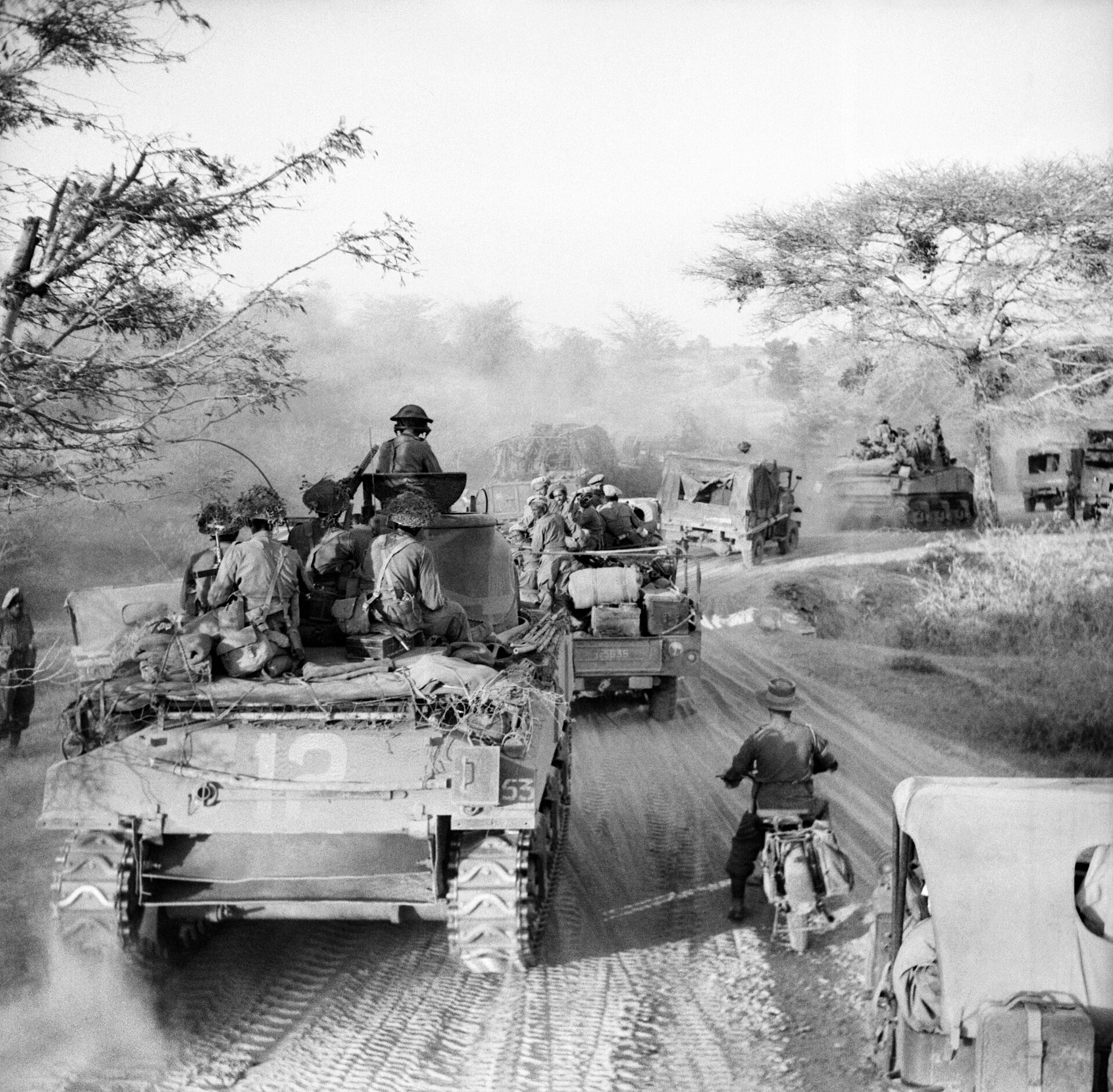
Slim made it appear his main attack was aimed at Mandalay, while secretly sending a powerful force south to seize Meiktila, the hub of Japanese communications and supply. Meiktila fell on 4 March. The Japanese counterattacked fiercely there, while the 19th Indian Division under Major General Pete Rees fought its way into Mandalay from the north.
Fort Dufferin
Mandalay Hill was taken on 9 March. The Japanese held out in Fort Dufferin, the old royal palace with its massive walls and moat, which resisted artillery and bombing. On 20 March the defenders withdrew, and the fort was entered.
Sources and further reading
Lead image: Sherman tanks of the British Fourteenth Army on the road to Meiktila. Sgt R. Stubbs, No 9 Army Film and Photographic Unit, Public domain, via Wikimedia Commons. See our sources and image policy.
 United Kingdom
 United States
 Soviet Union
 Germany
 Japan
 France
 Poland
 South Africa