Grand Strategy · Diplomacy · The Allies
The Yalta Conference
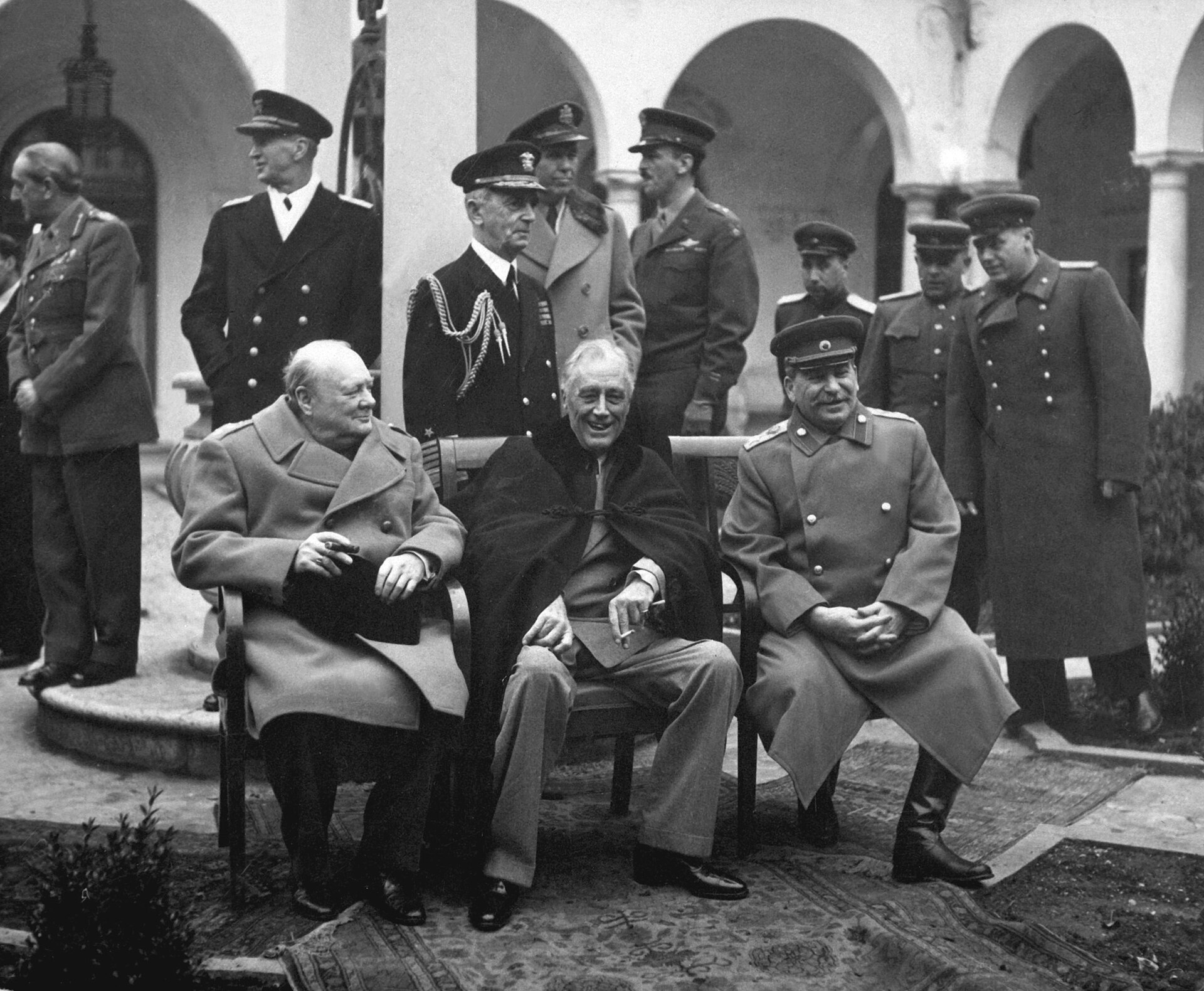
Roosevelt, Churchill and Stalin meet in a former tsar’s palace in the Crimea. They plan the end of the war and the shape of the peace.
- Location
- Livadia Palace, near Yalta, Crimea
- Dates
- 4 to 11 February 1945
- Leaders
- Franklin D. Roosevelt, Winston Churchill, Joseph Stalin
- Key outcomes
- Zones for Germany, Soviet entry into the war with Japan, the UN conference
- War clock
- Day 1,984 of 2,194
By February 1945 the Red Army stood on the Oder, close to Berlin, while the Western Allies were preparing to cross the Rhine. The Big Three had last met together at Tehran in late 1943. Now, with Germany’s defeat in sight, they met again at Yalta on the Black Sea, where Stalin was host.
Germany and Europe
The leaders agreed that Germany would be divided into zones of occupation, with France given a zone carved from the British and American areas, and that Germany would be disarmed and denazified. They signed a Declaration on Liberated Europe promising free elections. Poland’s eastern border was to follow roughly the Curzon Line, with compensation in the west, and its Soviet-backed provisional government was to be broadened before elections.
Japan and the United Nations
Stalin agreed to enter the war against Japan within three months of Germany’s defeat, in return for territorial and other concessions in the Far East. The leaders also settled arrangements for voting in the Security Council of the new United Nations and agreed to call its founding conference at San Francisco in April.
Sources and further reading
Lead image: Churchill, Roosevelt and Stalin at the Yalta Conference. US government photographer, Public domain, via Wikimedia Commons. See our sources and image policy.
 United Kingdom
 United States
 Soviet Union
 Germany
 Japan
 France
 Poland
 South Africa