Pacific · Land Battles · Australia and United States vs Japan
Victory at Buna and Gona
After two months of fighting in swamp and jungle on the north coast of Papua, the last Japanese resistance at Buna and Gona collapses.
- Location
- Buna, Gona and Sanananda, Papua
- Dates
- 16 November 1942 to 22 January 1943
- Allied forces
- Australian 7th Division, US 32nd Division
- Allied killed
- 1,991
- Japanese dead
- About 7,000
- War clock
- Day 1,240 of 2,194
After their advance on Port Moresby over the Kokoda Track was turned back in late 1942, the Japanese fell back to fortified beachheads at Buna, Gona and Sanananda on the north coast of Papua. Australian and American troops followed them over the mountains and attacked on 16 November 1942.
Bunkers and malaria
The Japanese held well-hidden bunkers of logs and earth among swamps and tall kunai grass. Early attacks failed with heavy losses, and General Robert Eichelberger was sent to take charge of the American effort, replacing the 32nd Division’s commander. Disease was as dangerous as the enemy: by one estimate up to 95 per cent of Allied soldiers in the area carried malaria, and for every battle casualty almost five men went to hospital sick.
The end
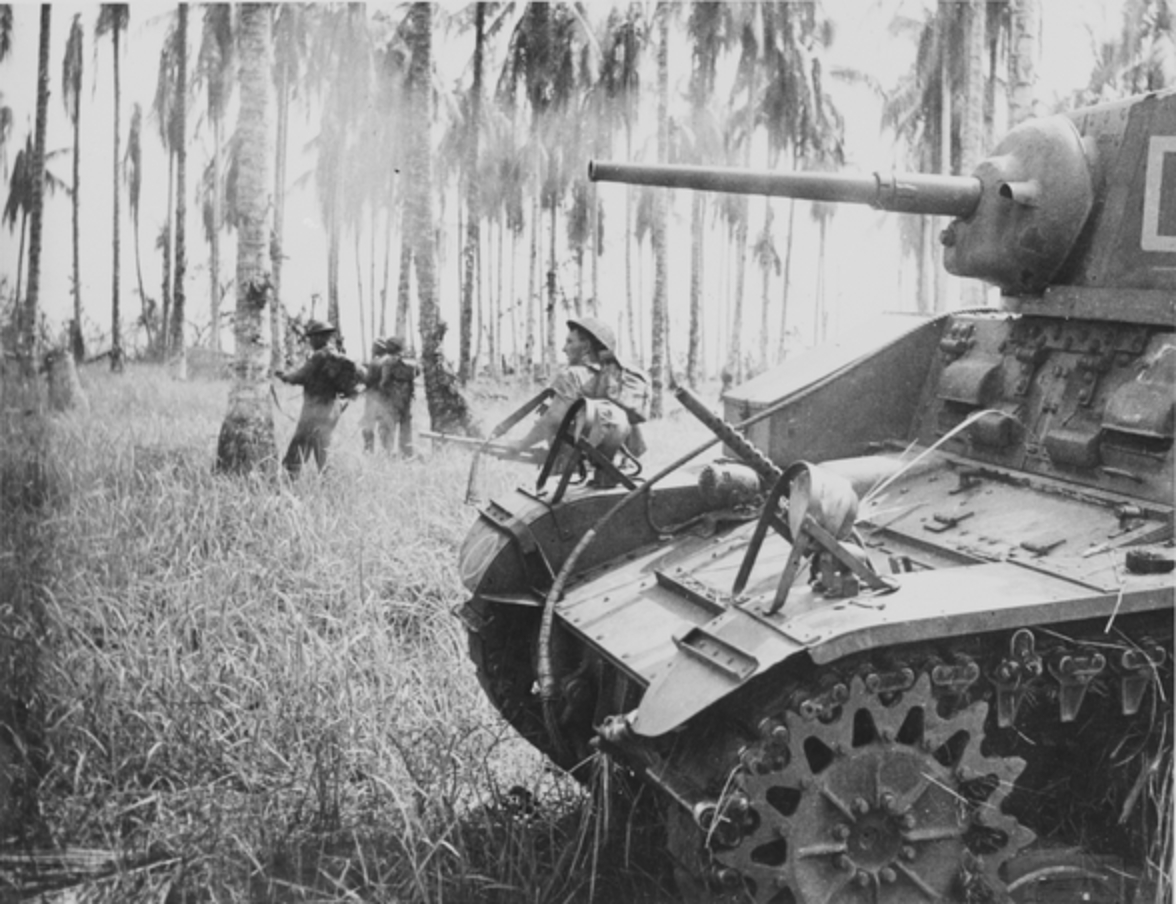
Gona fell to the Australians in December and Buna in early January, with M3 Stuart tanks helping to break the bunkers. The last resistance at Sanananda ended on 22 January 1943. The garrison fought almost to the last man: about 7,000 Japanese died, some 4,000 of them in battle and the rest from disease and hunger.
Sources and further reading
Lead image: Australian infantry advance with M3 Stuart tanks at Giropa Point, Buna, 7 January 1943. George Silk, Public domain, via Wikimedia Commons. See our sources and image policy.
 United Kingdom
 United States
 Soviet Union
 Germany
 Japan
 France
 Poland
 South Africa