Western Europe · Land Battles · United Kingdom and Canada vs Germany
Operation Infatuate: Storming Walcheren
Commandos cross the Scheldt and land on a flooded Dutch island to break the last German grip on the approaches to Antwerp, the port the Allied armies desperately need.
- Location
- Walcheren island, Zeeland, Netherlands
- Belligerents
- United Kingdom and Canada vs Germany
- Landings
- Flushing (Vlissingen) and Westkapelle, 1 November 1944
- Allied casualties
- 1,473, including 489 killed
- German losses
- About 1,200 killed and wounded, 2,900 captured
- War clock
- Day 1,889 of 2,194
Antwerp fell to the British in early September 1944 with its docks almost intact, but the great port was useless while German guns still commanded the 80 kilometres of the Scheldt estuary between the city and the sea. Through October the First Canadian Army fought a grinding battle on both banks. By the end of the month only one obstacle remained: the island of Walcheren, a saucer of reclaimed land ringed by dykes and studded with coastal batteries.
Flooding the island
Eisenhower approved bombing the dykes on 1 October. RAF Bomber Command breached the sea walls during October, and the North Sea poured in, flooding most of the island and leaving the German defenders on the high ground of the dunes and the towns. The Allies would now come by water.
Two landings at dawn
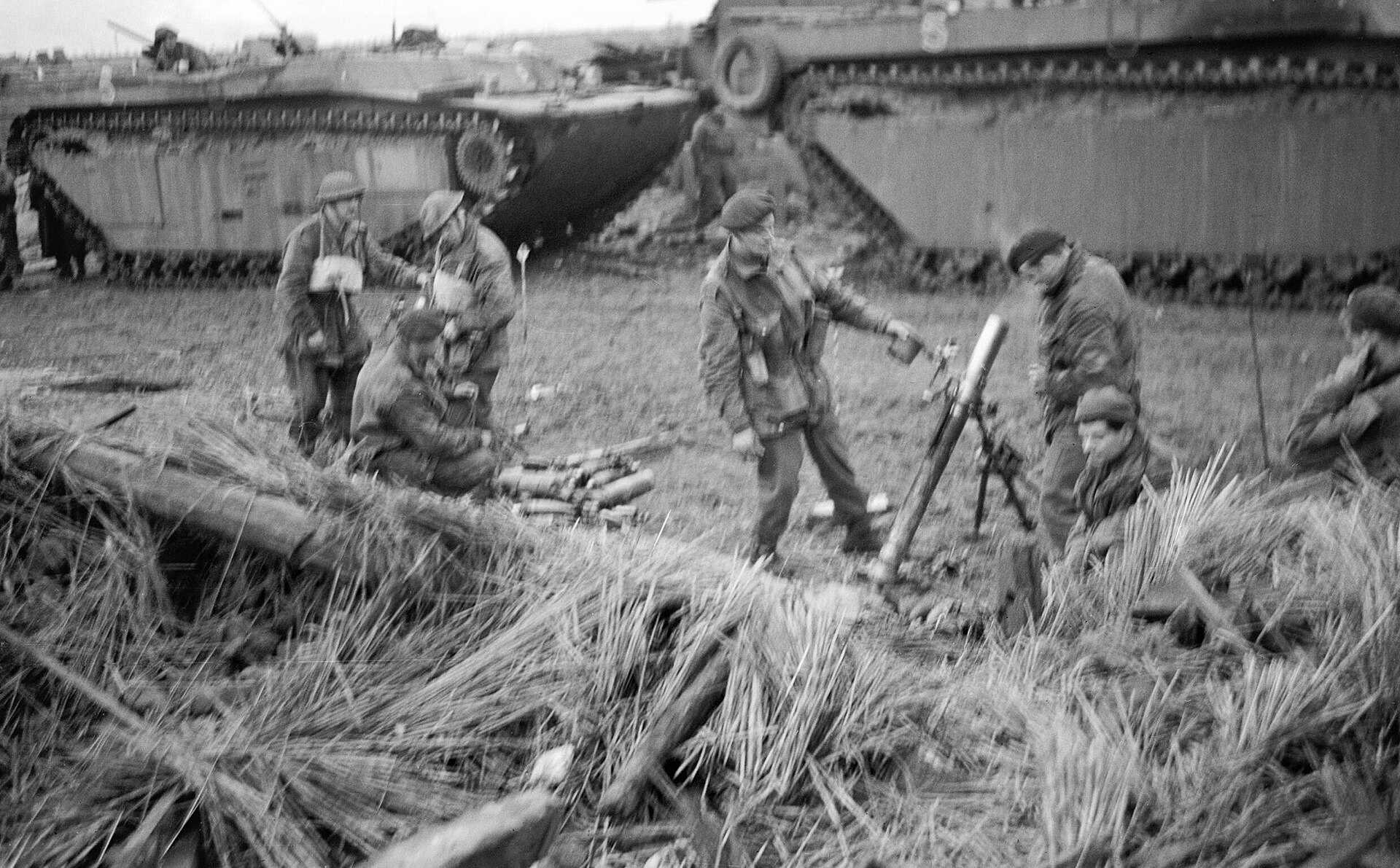
Before first light on 1 November, No. 4 Commando crossed from Breskens and landed at 05:45 just east of the Oranjemolen windmill at Flushing, with the main body ashore at 06:30. Troops of the 52nd (Lowland) Division followed them into the streets. Further west, the 4th Special Service Brigade had sailed from Ostend at 03:15 with Nos. 41, 47 and 48 Royal Marine Commandos and two troops of No. 10 (Inter-Allied) Commando, and went in through the gap the bombers had torn in the dyke at Westkapelle. The support squadron of landing craft took heavy losses from the batteries as the marines came ashore.
Meanwhile the 2nd Canadian Infantry Division fought to force the narrow Walcheren Causeway from the east. For a week the commandos cleared batteries, strongpoints and flooded villages, and the final phase began on 8 November, when the German garrison surrendered after negotiation.
The price of a port
The operation cost 1,473 Allied casualties, 489 of them killed. The No. 4 Special Service Brigade alone lost 103 killed, 325 wounded and 68 missing in eight days. About 2,900 Germans were taken prisoner. Even then Antwerp could not open at once: the Scheldt had to be swept of mines before the first cargoes were unloaded at the end of November.
Sources and further reading
Lead image: Commandos and amphibious vehicles at Westkapelle during the invasion of Walcheren, November 1944. No 5 Army Film & Photographic Unit, Public domain, via Wikimedia Commons. See our sources and image policy.
 United Kingdom
 United States
 Soviet Union
 Germany
 Japan
 France
 Poland
 South Africa