Grand Strategy · Politics · United States
Roosevelt Wins a Third Term
Breaking a tradition as old as the republic, Franklin D. Roosevelt is elected President for a third time, as Britain fights on alone and America edges towards war.
- Country
- United States
- Candidates
- Franklin D. Roosevelt (Democrat) vs Wendell Willkie (Republican)
- Popular vote
- 54.74% to 44.78%
- Electoral votes
- 449 to 82
- Turnout
- 62.5%
- War clock
- Day 432 of 2,194
Since George Washington refused a third term in 1796, no American President had served more than two. The rule was a custom rather than law, and in the summer of 1940, as German armies swept through western Europe, Franklin D. Roosevelt chose to break it. The Democratic convention renominated him, with Secretary of Agriculture Henry A. Wallace as his running mate.
A campaign shadowed by war
His Republican opponent, Wendell Willkie, was a businessman who had never held public office. Willkie attacked the New Deal and accused Roosevelt of secretly planning to take the country into the war. Roosevelt answered with a promise he would come to regret: that he would not send American boys into any foreign wars. At the same time, his administration was already helping Britain, trading 50 old destroyers for bases in September and introducing the first peacetime draft.
Election day
On 5 November 1940 Americans gave Roosevelt 27,313,945 votes, 54.74 per cent, against 22,347,744 for Willkie. He carried 38 states and won the electoral college by 449 votes to 82. Turnout was 62.5 per cent. Willkie, gracious in defeat, went on to support aid to Britain and travelled to London in early 1941 as an informal envoy.
Sources and further reading
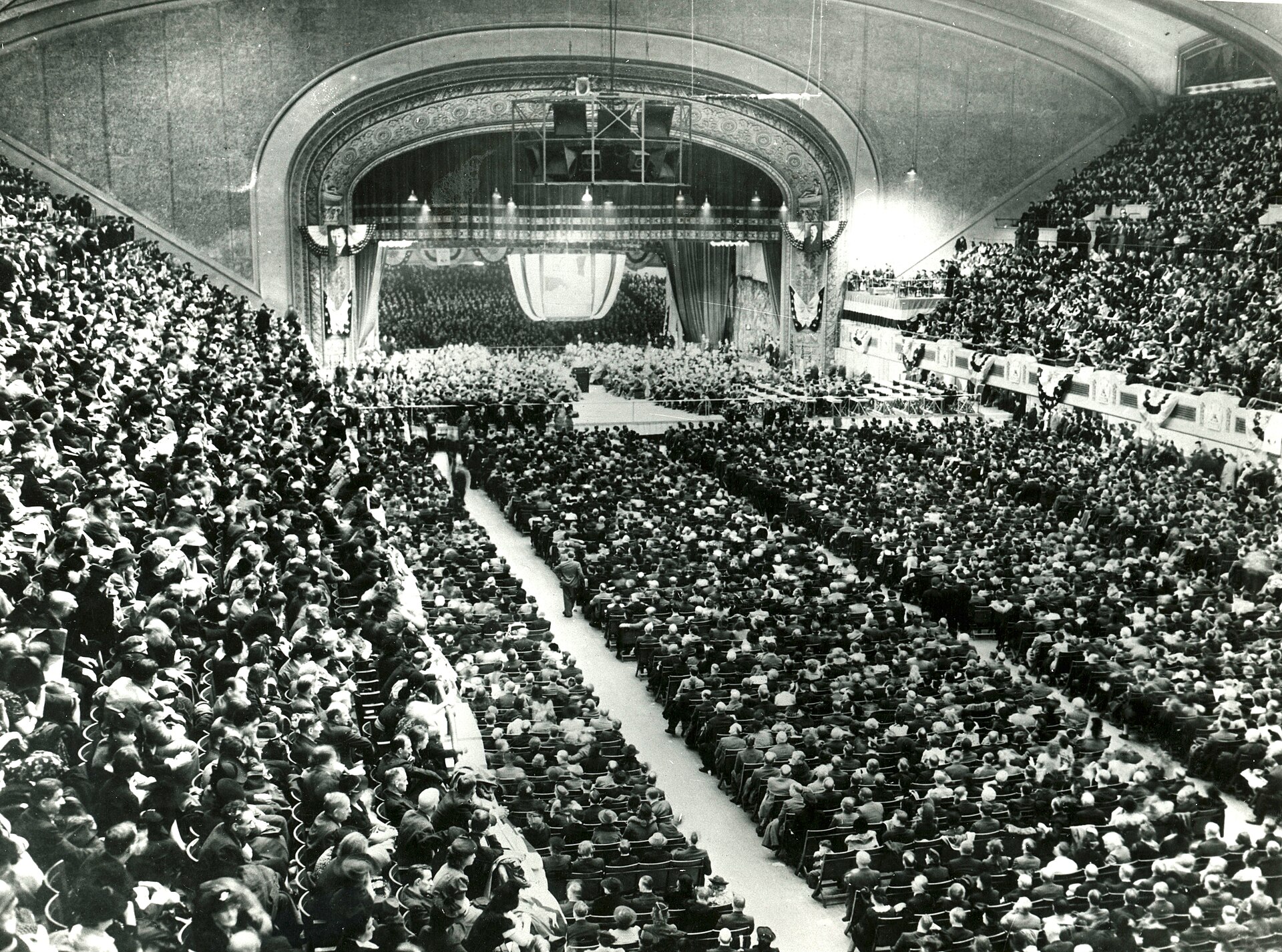
Lead image: Part of the overflow crowd at President Roosevelt’s campaign address in Cleveland, November 1940. FDR Presidential Library & Museum, CC BY 2.0 (licence), via Wikimedia Commons. See our sources and image policy.
 United Kingdom
 United States
 Soviet Union
 Germany
 Japan
 France
 Poland
 South Africa