Grand Strategy · Diplomacy · The Allies
The Moscow Declarations
At the end of a conference of foreign ministers in Moscow, the Allies sign declarations on the post-war world, on Austria and Italy, and on punishing German war criminals.
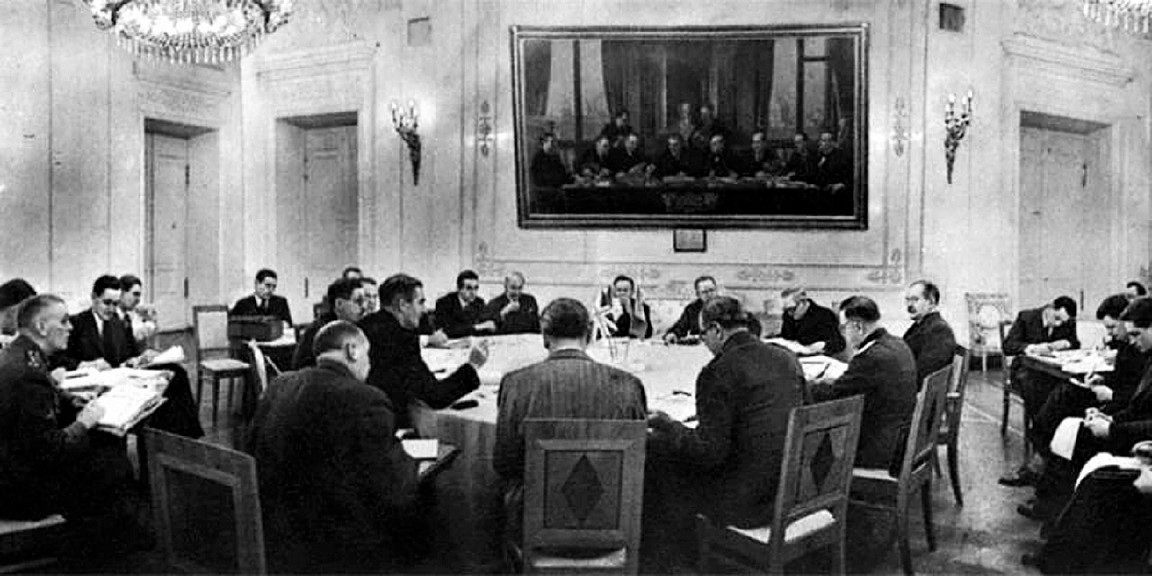
- Ministers
- Cordell Hull, Anthony Eden and Vyacheslav Molotov
- Conference
- 19 October to 1 November 1943
- Four Nations Declaration
- Also signed by China
- Atrocities declaration
- War criminals to be tried where their crimes were committed
- War clock
- Day 1,521 of 2,194
Before the first meeting of Roosevelt, Churchill and Stalin at Tehran, their foreign ministers met in Moscow to prepare the ground.
The declarations
On 30 October 1943 they signed a series of declarations. The Four Nations Declaration, joined by China’s ambassador, committed the major Allies to fight on until unconditional surrender and to create a general international organisation to maintain peace. A declaration on Austria called it the first free country to fall victim to Hitler’s aggression and promised its restoration. A declaration on Italy called for Fascism to be destroyed.
War crimes
The Declaration on Atrocities, signed by Roosevelt, Churchill and Stalin, warned that Germans responsible for atrocities would be sent back to the countries where they had committed their crimes to be judged. Major criminals whose crimes had no particular location would be punished by joint decision of the Allies.
Sources and further reading
Lead image: The Moscow Conference of foreign ministers, 1943. Mikhail Mikhaylovich Kalashnikov, Public domain, via Wikimedia Commons. See our sources and image policy.
 United Kingdom
 United States
 Soviet Union
 Germany
 Japan
 France
 Poland
 South Africa